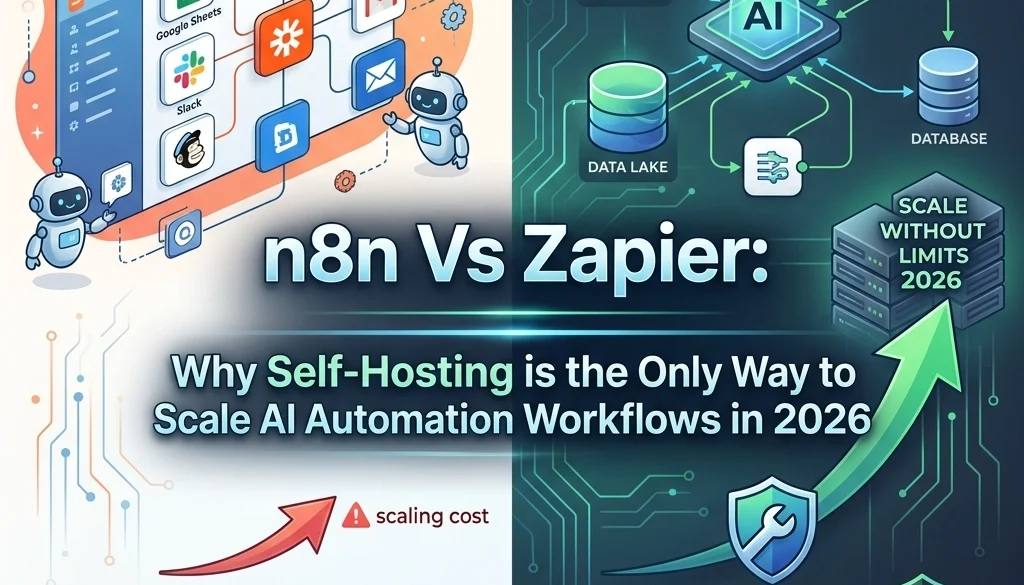
n8n Vs Zapier: Why Self-Hosting is the Only Way to Scale AI Automation Workflows in 2026
Automation Landscape Overview 2026
The enterprise automation landscape in 2026 is defined by two primary architectural methodologies: Software-as-a-Service (SaaS) and Self-Hosted Open-Source. Zapier represents the established SaaS model, while n8n serves as the primary alternative for organizations requiring granular control. The integration of Large Language Models (LLMs) into standard business processes has shifted the requirement from simple data synchronization to complex ai automation workflows.
Effective scaling in 2026 necessitates an evaluation of three critical factors: cost efficiency, data sovereignty, and architectural flexibility.
Cost Efficiency and Resource Allocation
Task-Based Pricing vs. Execution-Based Pricing
Zapier utilizes a task-based pricing model. In this structure, every action performed by a workflow incurs a discrete cost. For ai automation workflows that involve multi-step reasoning, data retrieval, and iterative processing, a single execution may consist of 20 to 50 tasks.
Zapier Cost Components:
- Base Subscription: Monthly fee for platform access.
- Task Quota: Fixed limit on the number of actions.
- Overage Charges: High per-task costs for exceeding monthly limits.
In contrast, n8n utilizes an execution-based model. A workflow run is counted as a single execution regardless of the internal complexity or number of nodes triggered. When self-hosted, the primary costs are shifted from software licensing to infrastructure maintenance.

Scaling Financial Analysis
For Small to Medium Businesses (SMBs), the financial trajectory of Zapier becomes unsustainable at high volumes. An automated customer support agent processing 10,000 interactions per month, with each interaction requiring 10 steps, generates 100,000 tasks. Under Zapier's 2026 pricing, this often exceeds $2,000 USD per month.
Self-hosting n8n via open-source deployment utilizes a fixed-cost infrastructure. A Virtual Private Server (VPS) capable of handling 100,000 executions typically costs between $40 and $100 USD per month. This represents a 95% reduction in operational expenditure for high-volume automation. Organizations can reference the ai automation roi calculator to determine specific break-even points.
Data Privacy and Infrastructure Sovereignty
SaaS Data Exposure
Zapier functions as a third-party intermediary. All data processed through a Zapier workflow must transit through Zapier’s cloud environment. For businesses handling sensitive information, including PII (Personally Identifiable Information), financial records, or proprietary AI training data, this introduces significant risk factors.
Security Constraints in SaaS:
- Data Residency: Lack of control over geographical data storage.
- Third-Party Access: Data is subject to the security protocols and vulnerabilities of the provider.
- Compliance Limitations: Challenges in meeting strict HIPAA, GDPR, or SOC2 requirements when data moves through external logic engines.
Self-Hosted Security Advantages
Self-hosting n8n ensures that data remains within the organization’s controlled infrastructure. This is critical for businesses implementing self-hosting llms. By keeping the automation engine and the AI models on the same private network, data transit over the public internet is eliminated.

Infrastructure Benefits:
- End-to-End Encryption: Direct control over encryption keys and transit protocols.
- Internal Integration: Direct connection to internal databases (SQL, NoSQL) without exposing ports to the public web.
- Audit Logs: Full access to execution logs for forensic and compliance auditing.
Marketrun provides n8n deployment services that configure these environments to meet enterprise security standards.
Technical Flexibility and AI Orchestration
Native AI Integration
The primary differentiator in 2026 is the capacity for AI orchestration. n8n has integrated native support for LangChain and AI Agent frameworks. This allows for the creation of autonomous agents that can reason, use tools, and maintain memory state across sessions.
n8n AI Capabilities:
- Vector Database Nodes: Native integration with Pinecone, Weaviate, and Milvus for Retrieval-Augmented Generation (RAG).
- Agentic Workflows: The ability to define "AI Agents" that dynamically choose which tools to use based on the input.
- Memory Management: Persistent storage of conversation history within the workflow logic.
Zapier provides "Central" for AI, but it remains a closed system with limited customization. It lacks the ability to execute custom Python or JavaScript code within the AI chain to the extent that n8n allows.
Custom Code and Extensibility
Scaling ai automation workflows often requires custom data transformation. n8n permits the execution of complex code snippets within any node. This flexibility is essential for:
- Pre-processing unstructured data before LLM ingestion.
- Post-processing AI outputs for database entry.
- Complex branching logic that exceeds the capabilities of standard "If/Then" filters.

Scaling SMB Operations
Long-term Reliability
As an SMB grows, the complexity of its internal logic increases. Zapier’s "no-code" focus, while accessible for simple tasks, becomes a hindrance for sophisticated operations. The visual interface of n8n is designed for professional engineers and technical operators, supporting version control and environment staging (Development, Testing, Production).
Marketrun Implementation Strategy
For businesses transitioning from basic SaaS tools to robust automation, the migration requires professional oversight. Marketrun offers custom software development and ai development services to bridge the gap between initial setup and enterprise-grade deployment.
Implementation Phases:
- Infrastructure Setup: Deployment of n8n on secure, scalable cloud instances.
- Workflow Migration: Rebuilding existing Zapier tasks into optimized n8n executions.
- AI Integration: Connecting workflows to self-hosted LLMs for enhanced privacy and performance.
- Maintenance: Ongoing updates and node management.

Comparative Analysis Summary
| Feature | Zapier (SaaS) | n8n (Self-Hosted) |
|---|---|---|
| Pricing Model | Per Task (High Cost at Scale) | Per Execution (Low Cost at Scale) |
| Data Privacy | Third-party cloud processing | In-house infrastructure |
| AI Capabilities | Basic API calls / Closed AI Central | Native LangChain / RAG / AI Agents |
| Technical Depth | Limited custom code | Full JS/Python support |
| Deployment | Immediate | Requires setup (n8n deployment services) |
Strategic Recommendations for 2026
For organizations prioritizing rapid prototyping and low-volume tasks (less than 1,000 tasks/month), Zapier remains a viable entry point. However, for any organization intending to integrate ai agents and automations into their core business logic, self-hosting is the standard.
The transition to self-hosted n8n facilitates:
- Unlimited workflow complexity without financial penalty.
- Absolute data sovereignty for compliance and competitive advantage.
- The ability to leverage the latest open-source AI innovations via LangChain nodes.
Marketrun assists businesses in navigating this transition, ensuring that infrastructure is optimized for both current needs and future scaling requirements. Explore our solutions for more information on professional deployment.

Technical Resources
Additional documentation on scaling and AI deployment can be found in our technical blog:
The current state of automation requires a move away from restrictive SaaS models toward flexible, self-managed environments. n8n provides the necessary framework to achieve this transition.