Do You Really Need Monthly SaaS Subscriptions? Here’s the Truth About Going SaaS-Free
SaaS Expenditure Analysis
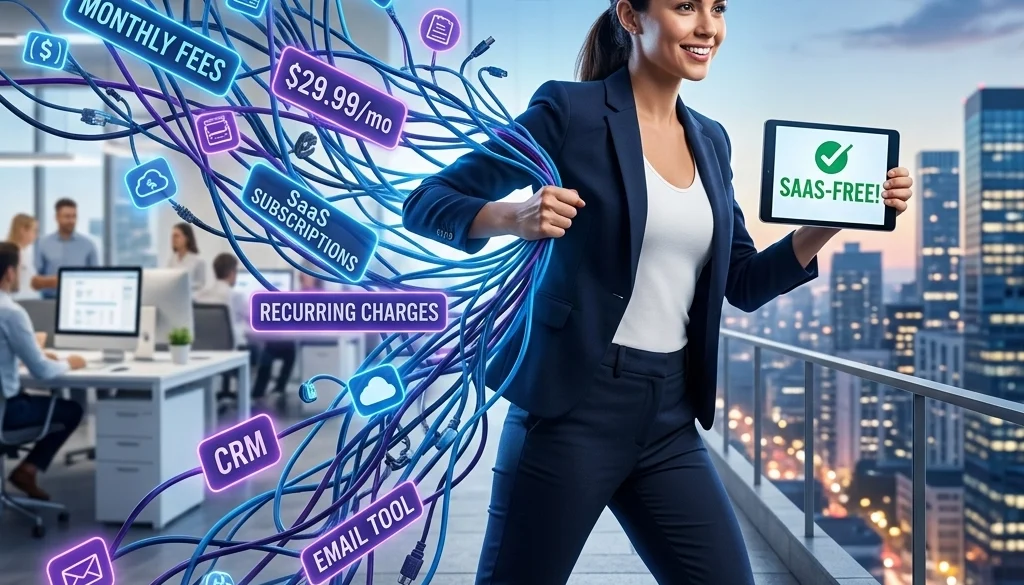
Software as a Service (SaaS) models rely on recurring revenue. Most organizations utilize dozens of tools. Individual costs appear negligible. Aggregate monthly expenses are significant.
In 2026, the average enterprise spends substantial capital on software licensing. These costs are permanent. Access terminates upon payment cessation. Data resides on third-party servers. Control is limited.
Eliminating SaaS subscriptions requires a transition to self-hosted infrastructure. This process involves utilizing open source saas alternatives. The objective is to achieve software ownership.
The Cumulative Cost Problem
Monthly billing cycles obscure total cost of ownership (TCO). A $50 per month tool costs $3,000 over five years. A suite of ten such tools costs $30,000. These figures exclude price increases.
Annual contracts offer discounts. They do not resolve the lack of ownership. Ownership is achieved through self-hosting.
Open Source SaaS Alternatives
Open-source software provides equivalent functionality to proprietary SaaS. Code is transparent. Licensing fees are absent.
Customer Relationship Management (CRM)
Proprietary CRMs like Salesforce or HubSpot require high monthly per-user fees.
Alternative: SuiteCRM or Odoo.
These platforms manage leads, sales pipelines, and customer data. They are hosted on private servers. Data privacy is maintained.
Project Management and Collaboration
Tools like Slack or Jira utilize per-user pricing. Costs scale with team size.
Alternative: Rocket.Chat, Mattermost, or Nextcloud.
Rocket.Chat provides real-time communication. Nextcloud offers file storage and document collaboration. These tools replicate the SaaS experience without the recurring fee.
Marketing and Analytics
Google Analytics and HubSpot Marketing Hub track user behavior. They utilize third-party cookies and centralized data storage.
Alternative: Matomo or Plausible.
These tools provide privacy-compliant analytics. Data is stored on-premise.

VPS Setup and Management
Self-hosting requires infrastructure. A Virtual Private Server (VPS) is the primary requirement.
Selecting a VPS Provider
Providers include DigitalOcean, Linode, Hetzner, and AWS. Selection criteria include:
- CPU performance.
- RAM allocation.
- NVMe storage capacity.
- Bandwidth limits.
- Geographic location.
Operating System Installation
Linux is the standard environment. Ubuntu Server and Debian are common choices. They are lightweight and stable.
VPS Setup and Management Steps
- Initial Server Hardening: Disable root login. Enable SSH key authentication. Configure a firewall (UFW or IPTables).
- Containerization: Use Docker and Docker Compose. This isolates applications. It simplifies updates.
- Reverse Proxy Setup: Install Nginx or Traefik. This manages incoming traffic. It routes requests to specific containers.
- SSL Certification: Use Let's Encrypt. Automate renewals via Certbot.
Detailed technical guides for these processes are available at Marketrun Custom Software.
Technical Implementation Framework
Successful transition requires a structured approach.
Data Migration
SaaS providers often facilitate data export. CSV or JSON formats are standard. This data must be mapped to the new open-source database schema.
Integration Management
SaaS tools often connect via native integrations. Self-hosted tools utilize APIs. Tools like n8n or Node-RED replace Zapier. They automate workflows between self-hosted applications.
Security Protocols
Self-hosting shifts security responsibility to the organization.
- Regular security patches.
- Encrypted backups.
- Multi-factor authentication (MFA).
- VPN access for internal tools.
For organizations requiring assistance with these protocols, Marketrun Solutions provides infrastructure management services.

Self-Hosting Artificial Intelligence
AI is a significant driver of SaaS costs. Proprietary LLM APIs charge per token.
Local LLM Deployment
Open-source models like Llama 3 or Mistral can be self-hosted. This eliminates per-use costs. Privacy is absolute.
Hardware requirements for AI hosting:
- High-VRAM GPUs (NVIDIA A100 or H100 for enterprise).
- Sufficient system memory.
Additional details on this transition are located in our self-hosting LLMs 2026 guide.
Economic Comparison: SaaS vs. Self-Hosted
Financial impact is measurable.
| Metric | Proprietary SaaS | Self-Hosted (VPS) |
|---|---|---|
| Monthly Fee | $500 – $5,000+ | $20 – $200 (VPS cost) |
| Data Ownership | Third-party | Full Ownership |
| Customization | Limited | Absolute |
| Scalability | Pay-per-user | Resource-based |
| Setup Cost | Low | Moderate |
The ROI of self-hosting is realized within 6 to 18 months. Ongoing costs are limited to server maintenance and electricity.

Risks and Mitigation
Self-hosting introduces specific risks.
Downtime
SaaS providers guarantee uptime. A self-hosted server depends on the VPS provider and internal management.
Mitigation: Use high-availability configurations. Implement automated monitoring via Uptime Kuma.
Maintenance Requirements
Software requires updates. Databases require optimization.
Mitigation: Automate updates using tools like Watchtower. Utilize professional management services for complex environments.
Marketrun offers open source deployment solutions to handle these operational tasks.
The Role of Custom Software
Open-source alternatives cover 90% of business needs. The remaining 10% requires custom development.
Building proprietary software assets increases company valuation. It creates a competitive advantage. It eliminates the limitations of "off-the-shelf" software.
Information regarding custom development for varied markets is available for US clients and India clients.

Strategic Roadmap for Going SaaS-Free
- Inventory: List all current SaaS subscriptions and monthly costs.
- Prioritize: Identify tools with the highest cost or lowest utility.
- Prototype: Deploy an open-source alternative on a small VPS.
- Migrate: Transfer data. Train staff.
- Decommission: Cancel the original SaaS subscription.
Infrastructure for 2026 and Beyond
The trend toward decentralization is accelerating. Organizations are prioritizing data sovereignty.
Modern VPS management tools simplify the transition. One-click deployments are common. AI-driven automation manages server health.
The "SaaS-free" path is a transition from an OpEx (Operating Expense) model to a CapEx (Capital Expenditure) and ownership model. This shift improves margins. It protects data.

Technical Resources
For further technical specifications on infrastructure and automation:
- Explore AI Automations.
- Review Mobile and Web App Development.
- Analyze AI ROI for transitions.
Marketrun provides the expertise required for VPS setup and management. We facilitate the migration from recurring subscriptions to owned assets.
The truth about going SaaS-free: it requires initial technical effort. It results in permanent financial savings and total data control.
Consult the Marketrun Blog for ongoing updates on open-source technology and custom software trends. Check our pricing for managed deployment options.