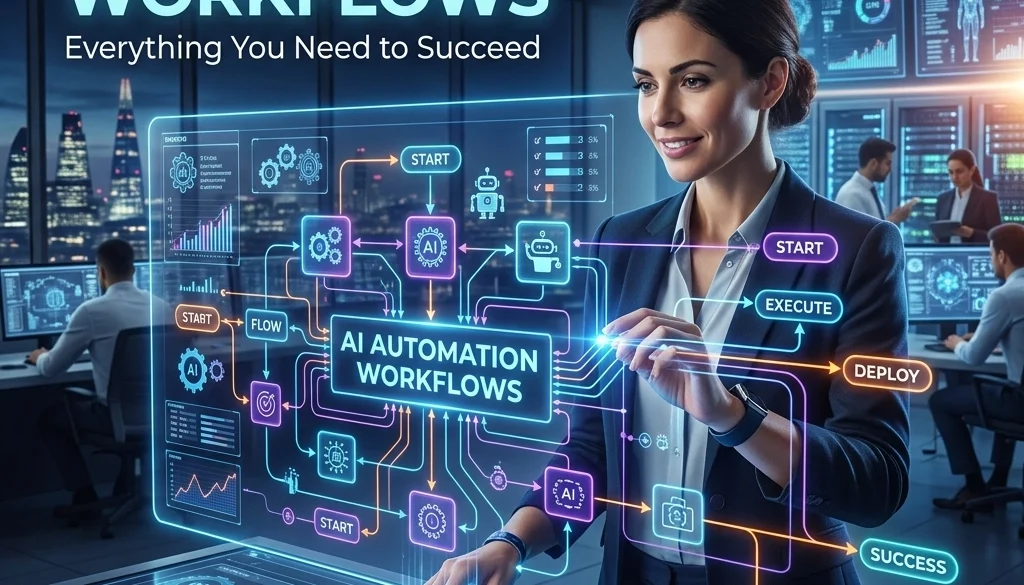
The Ultimate Guide to AI Automation Workflows: Everything You Need to Succeed
Definition of AI Automation Workflows
AI automation workflows are sequences of operations where artificial intelligence models perform decision-making, data processing, and task execution tasks. These workflows differ from traditional automation by the inclusion of cognitive capabilities. Traditional automation relies on static "if-this-then-that" logic. AI automation utilizes large language models (LLMs), machine learning algorithms, and natural language processing to handle unstructured data and variable conditions.
To automate business operations with ai, systems must interpret context. This allows for the management of tasks previously requiring human intervention, such as content moderation, sentiment analysis, and complex data extraction.
Core Components of the AI Automation Stack
The implementation of ai automation workflows requires a specific technical stack. Each component serves a distinct function in the processing pipeline.
1. Data Ingestion Layer
Data ingestion involves the collection of inputs from various sources. Inputs include structured data from databases and unstructured data from emails, PDFs, and social media feeds. This layer acts as the entry point for the workflow.
2. Orchestration Layer
The orchestration layer manages the movement of data between systems. It defines the sequence of events and handles the conditional logic that routes data to specific AI models or human-in-the-loop (HITL) stations.
3. Intelligence Layer (AI Models)
This layer consists of the AI models. These may be hosted through third-party APIs or deployed via self-hosting LLMs for increased security and data sovereignty. The intelligence layer performs reasoning, summarization, and classification.
4. Integration Layer
The integration layer connects the workflow to external business applications. This is facilitated through Application Programming Interfaces (APIs), webhooks, and middleware.

Technical Architecture for Connecting Disparate Systems
Successful operations require the connection of disparate software systems. Fragmentation of data across various platforms is a primary barrier to efficiency.
API-Centric Connectivity
API-centric connectivity allows different software packages to communicate. By leveraging REST or GraphQL APIs, data is transferred between Customer Relationship Management (CRM) systems, Enterprise Resource Planning (ERP) software, and communication tools like Slack or Microsoft Teams.
Webhook Triggers
Webhooks enable real-time automation. When an event occurs in one system: such as a new lead entry: a signal is sent to the AI workflow. This initiates immediate processing without the need for constant manual checks or polling.
Middleware and iPaaS
Integration Platform as a Service (iPaaS) solutions provide a centralized hub for managing connections. These platforms standardize data formats between systems that do not natively communicate. For businesses requiring high levels of security or specific logic, custom software development is utilized to build bespoke integration layers.
Advanced Strategies for AI Automation Workflows
Advanced workflows incorporate multi-step reasoning and agentic behaviors. These strategies increase the autonomy of the system.
Agentic Workflows
AI agents operate with a degree of independence. An agent is provided with a goal and a set of tools. It determines the sequence of actions required to achieve the goal. This is detailed further in the AI agents and automations guide.
Retrieval-Augmented Generation (RAG)
RAG connects AI models to internal knowledge bases. This ensures that the outputs are grounded in company-specific data. It prevents hallucinations and provides the AI with the context necessary for accurate business operations.
Error Handling and Exception Logic
Automated systems must include protocols for errors. If a model confidence score falls below a defined threshold, the workflow routes the task to a human operator. This ensures reliability in production environments.

Implementing AI to Automate Business Operations
The process of implementation follows a structured sequence to ensure stability and performance.
Phase 1: Process Identification
Operational audits are conducted to identify repetitive, high-volume tasks. Processes with clear inputs and outputs are prioritized for initial automation efforts.
Phase 2: Workflow Mapping
A visual map of the current process is created. This map includes every decision point, data transfer, and human interaction. Areas where AI can replace manual logic are highlighted.
Phase 3: Model Selection and Tuning
The appropriate AI model is selected based on task complexity. Simple classification may require a smaller, faster model, while complex strategic analysis requires a high-parameter LLM. Information on selecting models for different markets can be found in the offshore web and mobile apps guide.
Phase 4: Integration and Testing
The workflow is built and integrated into the existing tech stack. Testing is conducted using historical data to validate accuracy. Adjustments are made to prompts and logic parameters during this phase.

Security, Privacy, and Compliance
Automation involving business data necessitates strict adherence to security protocols.
Data Encryption
All data in transit and at rest must be encrypted. Use of Transport Layer Security (TLS) is mandatory for data moving between disparate systems.
Access Control
Identity and Access Management (IAM) protocols ensure that only authorized systems and personnel can trigger or modify workflows. This minimizes the risk of unauthorized data exposure.
Sovereignty and Self-Hosting
For industries with high regulatory requirements, such as finance or healthcare, self-hosting models on private infrastructure is a preferred method. This prevents third-party providers from accessing sensitive information. Guidance on this is available in the self-hosting LLMs 2026 guide.
Measuring Performance and ROI
The efficacy of AI automation is measured through quantitative metrics.
Key Performance Indicators (KPIs)
- Cycle Time: The duration required to complete a single workflow instance.
- Error Rate: The frequency of outputs requiring correction.
- Cost Per Task: The total operational cost of the workflow compared to manual labor.
- Volume Capacity: The number of tasks the system can handle simultaneously without degradation.
ROI Calculation
Return on Investment (ROI) is calculated by comparing the development and maintenance costs of the automation against the saved labor hours and increased throughput. A dedicated AI automation ROI calculator can assist in these projections.

Future Trends in AI Automation
The landscape of AI automation is subject to continuous evolution.
Autonomous Agents
The shift from linear workflows to autonomous agents is increasing. Agents capable of multi-tool usage and self-correction are becoming standard in complex environments.
Low-Code/No-Code AI Integration
Tools that allow non-technical staff to build and modify ai automation workflows are expanding. This democratizes the ability to automate business operations with ai across different departments.
Specialized Domain Models
Generic models are being replaced by models fine-tuned for specific industries. These models offer higher accuracy for niche technical language and industry-standard procedures.
Operational Deployment with Marketrun
Marketrun provides the infrastructure and expertise required to deploy these systems. Services include AI automations and AI development. These solutions are designed to integrate into existing infrastructures to enhance operational efficiency.
For enterprises operating across regions, understanding the cost and logistical implications is necessary. Resources such as the custom software India vs USA guide provide data for informed decision-making.
The transition to AI-driven operations is a structured process requiring technical precision and strategic planning. Adherence to these guidelines ensures a functional and scalable automation framework.