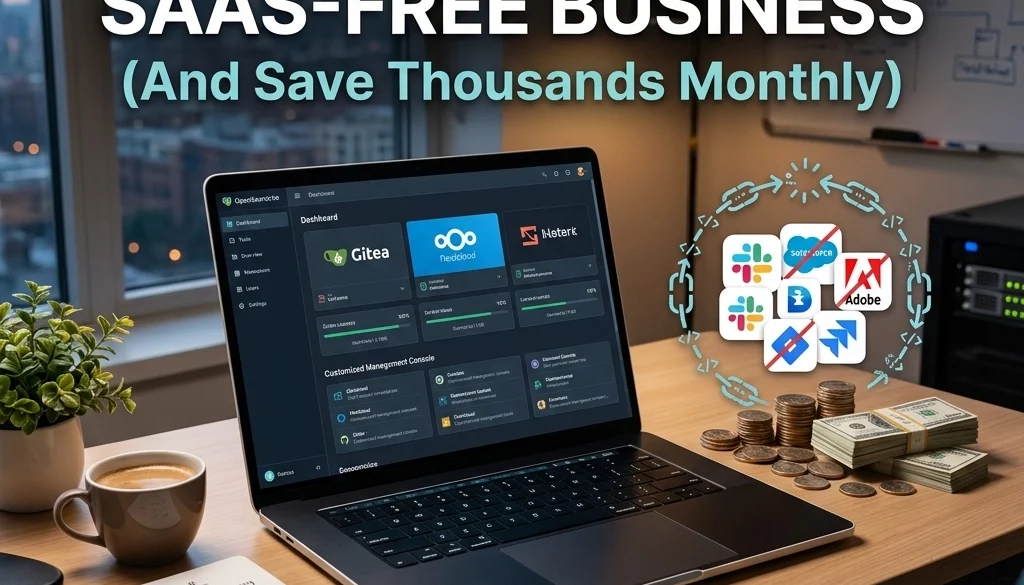
How to Build a SaaS-Free Business (And Save Thousands Monthly)
Subscription Liability Assessment
Software-as-a-Service (SaaS) consumption generates recurring monthly liabilities. Most modern enterprises operate on 20 to 50 individual subscriptions. This results in significant "SaaS creep," where underutilized tools contribute to capital inefficiency.
Cumulative costs for a small team often exceed $2,000 monthly for basic operations:
- CRM: $150–$300
- Project Management: $100–$200
- Email Marketing: $150–$400
- Analytics: $50–$150
- Document Collaboration: $100–$200
- AI Tools: $200–$500
Replacing these with self-hosted, open-source alternatives shifts expenditure from recurring operational costs to fixed infrastructure costs. Marketrun provides custom software solutions to facilitate this transition.
Infrastructure Architecture: The Virtual Private Server (VPS)
A SaaS-free business requires owned infrastructure. Virtual Private Servers (VPS) allow for the hosting of multiple applications on a single resource.
Provider Selection
- Hetzner/DigitalOcean/Linode: High reliability, fixed pricing.
- Self-managed Hardware: Maximum sovereignty, requires physical maintenance.
A standard VPS configuration (8GB RAM, 4 CPUs) typically costs $20–$40 monthly. This single instance can host an entire business suite using containerization.
Containerization with Docker
Docker facilitates the isolation of applications. Each software tool operates in its own container, sharing the host OS resources while maintaining independent dependencies.
- Efficiency: Higher resource utilization compared to dedicated SaaS instances.
- Portability: Ease of migration between providers.
- Management: Simplified updates and rollbacks.

Open Source Software (OSS) Mapping
To eliminate SaaS costs, identify proprietary tools and replace them with functionally equivalent open-source alternatives.
Communication and Collaboration
- Slack/Discord Alternative: Mattermost or Rocket.Chat. These platforms provide real-time messaging, file sharing, and integration capabilities without per-user licensing fees.
- Zoom Alternative: Jitsi Meet or BigBlueButton. Self-hosted video conferencing eliminates meeting time limits and data privacy concerns.
Customer Relationship Management (CRM)
- Salesforce/HubSpot Alternative: SuiteCRM or EspoCRM. These tools manage lead tracking, sales pipelines, and customer data. Data is stored locally, ensuring compliance and security.
Marketing and Analytics
- Mailchimp/Klaviyo Alternative: Mautic or Listmonk. Automated email sequences and newsletter management are handled on the VPS. There are no costs associated with subscriber count increases.
- Google Analytics Alternative: Matomo or Umami. These provide privacy-focused tracking and full ownership of visitor data.
Artificial Intelligence
- ChatGPT Alternative: Local Large Language Models (LLMs). Hosting models on private infrastructure prevents data leakage. Detailed guidance is available in the self-hosting LLMs 2026 guide.

Technical Implementation: VPS Setup and Management
The transition to a SaaS-free model follows a structured technical deployment.
1. Server Hardening
Initial setup requires security protocols to prevent unauthorized access:
- SSH Key Authentication: Disabling password logins.
- Uncomplicated Firewall (UFW): Restricting traffic to essential ports (80, 443, 22).
- Fail2Ban: Automated IP banning for brute-force attempts.
2. Reverse Proxy Configuration
A reverse proxy (Nginx, Traefik, or Caddy) manages incoming traffic. It routes requests to the correct Docker container and handles SSL certificate issuance via Let’s Encrypt.
- SSL/TLS: Automated encryption for all hosted services.
- Subdomain Mapping: Assigning specific tools to subdomains (e.g., crm.company.com).
3. Database Management
Most OSS tools require a database (PostgreSQL, MySQL, or MariaDB).
- Internal Networking: Databases should remain internal to the Docker network, not exposed to the public internet.
- Persistent Storage: Mapping container data to host volumes ensures data survival during container restarts.

Data Sovereignty and Security
Ownership of software necessitates ownership of security.
Backup Protocols
SaaS providers handle backups; in a self-hosted model, this responsibility is internal.
- Automated Off-site Backups: Tools like Restic or BorgBackup should encrypt and transmit data to a separate storage location (e.g., S3-compatible storage).
- Redundancy: Implementation of RAID or frequent snapshots at the VPS provider level.
Privacy Compliance
Self-hosting inherently simplifies GDPR and CCPA compliance. Data remains within defined geographic jurisdictions. No third-party data processing agreements are required for core operational tools. Marketrun assists with open source deployment to ensure these standards are met.
Financial Impact Analysis
The primary objective of a SaaS-free business is the reduction of the burn rate.
Comparative Cost Projection (Annual)
| Tool Category | SaaS Cost (Yearly) | Self-Hosted Cost (Yearly) |
|---|---|---|
| Infrastructure | $0 | $480 (VPS + Storage) |
| CRM | $2,400 | $0 |
| Email Marketing | $1,200 | $0 |
| Analytics | $600 | $0 |
| Project Mgmt | $1,500 | $0 |
| Total | $5,700 | $480 |
The ROI of transitioning is realized within the first quarter of operation. Businesses can utilize the AI automation ROI calculator to project specific savings based on current headcount.

Maintenance and Operational Requirements
Self-hosted infrastructure requires periodic maintenance.
- Updates: Security patches for the host OS and Docker images must be applied monthly.
- Monitoring: Tools like Uptime Kuma or Grafana monitor server health and service availability.
- Scaling: As team size increases, the VPS can be scaled vertically (adding RAM/CPU) without per-user price increases.
For organizations lacking internal DevOps capacity, Marketrun offers pricing tiers for managed deployment and maintenance services.
Deployment Roadmap
To move toward a SaaS-free model, follow this sequence:
- Audit: List every current SaaS subscription and monthly cost.
- Prioritize: Identify the highest-cost or most data-sensitive tools for immediate replacement.
- Provision: Set up a VPS and configure basic security.
- Migrate: Export data from SaaS tools and import into OSS alternatives.
- Validate: Ensure backup systems are functional before canceling subscriptions.

Strategic Summary
The SaaS-free business model prioritizes capital efficiency and data control. By utilizing Virtual Private Servers and Open Source Software, enterprises eliminate recurring subscription liabilities. This architectural shift provides long-term financial stability and operational independence. Implementation requires technical proficiency in VPS management and Docker, or partnership with specialized firms. Marketrun facilitates the transition from subscription dependence to owned infrastructure through professional open source deployment services.