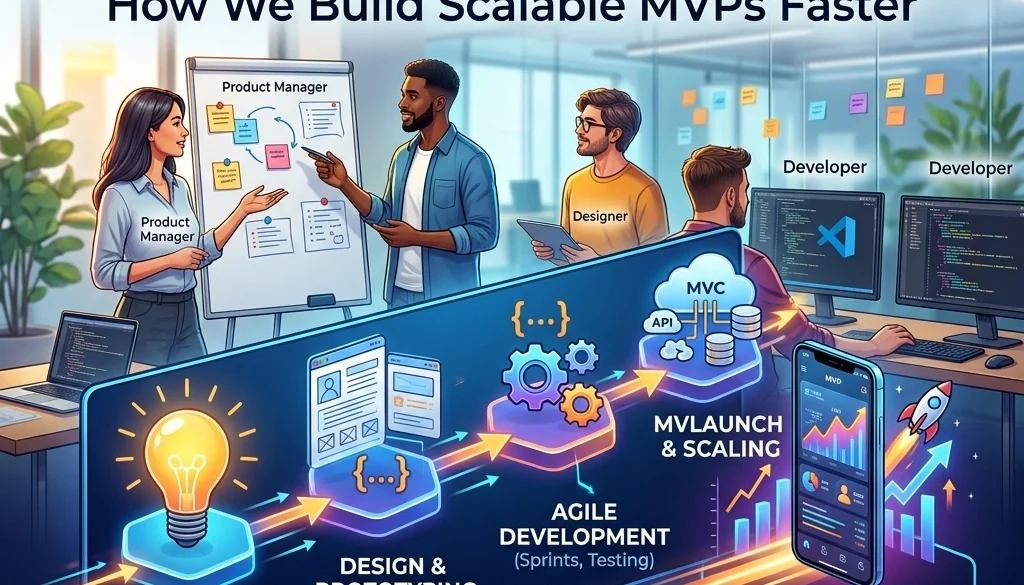
The Proven Application Development Framework: How We Build Scalable MVPs Faster
Framework Overview
The application development process at Marketrun is governed by a structured framework designed for the rapid deployment of Minimum Viable Products (MVPs). This framework prioritizes scalability, modularity, and technical debt mitigation. It is utilized for both mobile and website development projects to ensure consistency between initial ideation and final production.
The framework consists of six distinct phases: System Definition, Architectural Strategy, Modular Execution, Quality Assurance, Infrastructure Deployment, and Scaling Optimization. Each phase is executed with a focus on functional requirements and technical efficiency.
Phase 1: System Definition (Sprint Zero)
Sprint Zero is the foundational stage of the application development framework. During this period, all project parameters are established. The objective is to align technical capabilities with business objectives before any code is generated.
Component Identification
Core features are isolated and categorized. This process prevents scope creep and ensures resources are allocated to the primary value proposition. Website development projects require the identification of user personas, navigation flows, and conversion paths.
Documentation and Specifications
Literal descriptions of system behavior are recorded. This includes:
- User stories and acceptance criteria.
- Entity-relationship diagrams for database design.
- API endpoint specifications.
- Wireframes for interface layout.

Phase 2: Architectural Strategy and Stack Selection
The selection of a technology stack is based on the requirement for high performance and horizontal scalability. Standardized configurations are preferred to minimize maintenance overhead.
Frontend Architecture
For website development and web applications, React and Vue.js are the primary frameworks utilized. These libraries allow for component-based development, which facilitates the reuse of UI elements across different sections of the application. For mobile environments, cross-platform solutions are prioritized to maintain a single codebase. More information on these services is available at Marketrun Solutions.
Backend and Database Systems
Backend systems are constructed using Node.js or Python, depending on the complexity of data processing requirements. Database selection is determined by data structure:
- Relational Databases (PostgreSQL): Utilized for structured data with complex relationships.
- NoSQL Databases (MongoDB): Utilized for semi-structured data requiring high-speed read/write operations.
Custom Software Integration
The framework incorporates custom software development protocols to ensure that external APIs and internal modules communicate through standardized protocols. This modularity ensures that components can be replaced or upgraded without system-wide disruption.
Phase 3: Modular Execution and Iterative Development
Development is conducted in two-week cycles (sprints). This iterative approach allows for the continuous integration of features and regular status assessments.
Development Workflow
- Task Assignment: Specific modules are assigned to developers based on technical expertise.
- Code Generation: Software is written according to the defined architectural standards.
- Peer Review: Code is scrutinized by secondary developers to ensure adherence to quality standards.
- Integration: Verified code is merged into the primary development branch.
Minimum Viable Product Focus
The execution phase adheres strictly to the MVP definition established in Phase 1. Features that do not contribute to the core functionality are deferred to subsequent versions. This strategy reduces time-to-market and allows for early user feedback. Technical considerations for cross-border development can be found in the Offshore Development Guide.
Phase 4: Quality Assurance and Automated Testing
Verification is an integrated component of the development lifecycle. Automated and manual testing protocols are implemented to ensure system stability and performance.
Testing Modalities
- Unit Testing: Individual functions and components are tested in isolation.
- Integration Testing: Interactions between different modules and third-party APIs are verified.
- End-to-End (E2E) Testing: The complete user journey is simulated to identify potential bottlenecks or failures in the application development process.
- Performance Testing: The system is subjected to simulated load to determine response times and resource consumption.

Phase 5: Infrastructure and Deployment Automation
Deployment is managed through automated CI/CD (Continuous Integration and Continuous Deployment) pipelines. This ensures that software updates are delivered to production environments without manual intervention.
Cloud Infrastructure
Applications are hosted on scalable cloud platforms such as AWS or Google Cloud. Infrastructure is managed as code (IaC), allowing for the rapid replication of environments.
Deployment Protocols
- Containerization: Applications are packaged into Docker containers to ensure consistency across development, staging, and production environments.
- Orchestration: Kubernetes or managed container services are used to manage deployment, scaling, and operational health.
- Open Source Implementation: Where applicable, open source deployment strategies are used to reduce licensing costs and increase transparency.
Phase 6: Scaling and Post-Release Optimization
Following the production release, the focus shifts to monitoring and incremental improvement. The framework transitions from creation to optimization.
Monitoring and Analytics
System health is monitored through automated logging and alerting systems. Performance metrics, error rates, and user engagement data are collected to inform future development cycles. Website development projects utilize SEO and performance monitoring tools to maintain visibility. Detailed strategies for SEO can be explored in the AI Website SEO Guide.
Scaling Strategies
Horizontal scaling is achieved by increasing the number of active instances in response to traffic volume. Vertical scaling is achieved by increasing the resource allocation (CPU/RAM) to existing instances. The efficiency of these optimizations can be measured using the AI Automation ROI Calculator.
Cost Considerations and Regional Variations
The financial implications of application development vary based on the geographic location of the development team. Marketrun facilitates a comparison of development costs and quality between different regions.
- India-based Development: Focuses on high-volume output and cost efficiency. Information is available for India Clients.
- US-based Development: Prioritizes localized project management and specific regulatory compliance. Information is available for US Clients.
A detailed comparison of these options is documented in the Custom Software India vs USA report.
AI Integration and Future Capability
Modern application development frequently necessitates the integration of artificial intelligence. The framework supports the implementation of AI agents and Large Language Models (LLMs) to enhance functionality.
AI Development Modules
- Automation: Implementation of AI automations to handle repetitive tasks.
- Custom AI Models: Development of bespoke AI solutions tailored to specific datasets.
- Self-Hosting: For data privacy and cost control, the framework supports self-hosting LLMs.

Conclusion of Process
The application development framework utilized by Marketrun is a systematic approach to software engineering. By adhering to defined phases and technical standards, the transition from initial idea to production is executed with precision. This methodology ensures that MVPs are not only built quickly but are also prepared for the requirements of enterprise-level scaling.

Service Status
- Application Development: Active.
- Website Development: Active.
- Custom Software Solutions: Active.
- AI Automation: Active.
For further information regarding service pricing, refer to the Pricing Page. Technical updates and guides are regularly published on the Marketrun Blog.