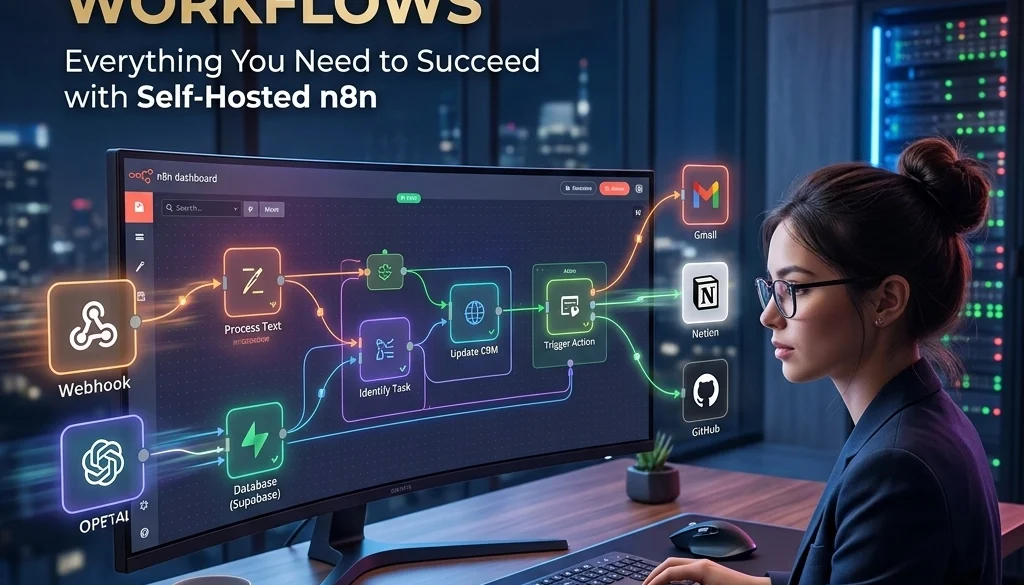
The Ultimate Guide to AI Automation Workflows: Everything You Need to Succeed with Self-Hosted n8n
Operational Overview: n8n and AI Automation Workflows
n8n is an extensible workflow automation tool. It utilizes a node-based interface to connect disparate software applications. Self-hosting this platform involves deploying the software on private infrastructure. This method removes execution limits and reduces subscription costs associated with cloud-based alternatives.
AI automation workflows within n8n utilize Large Language Models (LLMs) to process unstructured data. Small and Medium Businesses (SMBs) deploy these systems to perform tasks previously requiring manual intervention. Data indicates a reduction of 10 to 20 labor hours per week following successful implementation.
Efficiency Gains for SMBs
The integration of ai agents for business facilitates the automation of complex decision-making processes. Traditional automation relies on rigid "if-then" logic. AI-enhanced workflows utilize semantic understanding to interpret intent and context.
Time Recovery Metrics
- Data Entry and Synthesis: 5-7 hours saved weekly.
- Customer Inquiry Categorization: 3-5 hours saved weekly.
- Lead Qualification: 2-4 hours saved weekly.
- Report Generation: 2-4 hours saved weekly.
Total weekly operational recovery: 12-20 hours.
Detailed solutions for these implementations are available at marketrun.io/solutions/ai-automations.
Infrastructure: Self-Hosting vs. Cloud
Self-hosting n8n requires a Virtual Private Server (VPS) or local hardware. This configuration provides total control over the execution environment.
Hardware Requirements
- Processor: 2 vCPU minimum.
- Memory: 4GB RAM minimum (8GB recommended for AI nodes).
- Storage: 20GB SSD.
- Operating System: Linux (Ubuntu 22.04 LTS recommended).
Deployment Architecture
Deployment is typically achieved via Docker and Docker Compose. This ensures environment consistency. A standard stack includes:
- n8n Container: Application logic.
- PostgreSQL Container: Persistent database for workflow storage and execution history.
- Redis: Optional queue management for high-concurrency environments.
- Reverse Proxy (Traefik/Nginx): SSL termination and domain routing.
Further information on hosting configurations is located at marketrun.io/solutions/open-source-deployment.

AI Agents for Business: Core Components
The ai agents for business paradigm within n8n is built upon the AI Agent Node. This node utilizes LangChain integration to manage interactions between LLMs and external tools.
LLM Selection
Workflows require connection to an inference engine. Options include:
- Cloud APIs: OpenAI (GPT-4o), Anthropic (Claude 3.5), Google (Gemini).
- Self-Hosted LLMs: Llama 3 or Mistral deployed via Ollama or LocalAI.
Technical documentation for private model hosting is available at marketrun.io/self-hosting-llms.
The Tooling Ecosystem
AI agents function by selecting "tools" to complete a prompt. In n8n, any workflow or node can be defined as a tool.
- HTTP Request Tool: Interface with external APIs.
- Database Tool: Read/write operations on SQL or NoSQL stores.
- Custom Code Tool: Execution of JavaScript or Python logic.
AI Automation Workflows: Construction and Logic
Constructing ai automation workflows requires a sequential assembly of nodes. Each node represents a discrete function.
Workflow Triggering
Events initiate execution.
- Webhook: External signals.
- Cron: Scheduled intervals.
- Messaging: Triggers from Slack, Discord, or Email.
Vector Databases and Memory
For agents to maintain context, vector databases are utilized. These store information as high-dimensional vectors (embeddings).
- Pinecone: Cloud-based vector store.
- Supabase (pgvector): Integrated SQL and vector solution.
- Chroma: Open-source local vector storage.
Workflows use "Retrieval-Augmented Generation" (RAG) to query these databases before providing a response to the user. This ensures the AI utilizes specific business data rather than general training data.

Implementation Path: Lead Qualification Example
Lead qualification is a primary use case for ai automation workflows.
- Input: A new lead submits a form on a website.
- Trigger: n8n receives a webhook notification.
- Data Extraction: The AI Agent node analyzes the submission text.
- Enrichment: A tool node fetches company data from LinkedIn or Clearbit.
- Scoring: The AI evaluates the lead against predefined Ideal Customer Profile (ICP) criteria.
- Action:
- If score > 80: The agent notifies the sales team via Slack and creates a CRM entry.
- If score < 80: The agent sends an automated follow-up email with lower-tier resources.
This process eliminates manual screening. Related software development strategies are detailed at marketrun.io/solutions/custom-software.
Data Sovereignty and Security
Self-hosting n8n addresses primary security concerns for SMBs.
Privacy Benefits
- Data Locality: Sensitive customer data remains on company-controlled servers.
- Credential Management: API keys and database passwords reside in local environment variables.
- No Third-Party Analytics: Usage patterns are not tracked by SaaS providers.
Security Best Practices
- VPC Isolation: Host the instance within a Virtual Private Cloud.
- Regular Updates: Automate Docker image pulls to apply security patches.
- Encryption: Utilize TLS for all incoming and outgoing connections.
Strategic planning for secure deployments is found at marketrun.io/solutions/ai-development.

Resource Management and Scaling
Scaling ai automation workflows requires monitoring server utilization. High-frequency workflows increase CPU and RAM demands, particularly when executing Python code or processing large JSON objects.
Scaling Strategies
- Horizontal Scaling: Deploy multiple worker instances of n8n.
- Load Balancing: Distribute incoming traffic across nodes.
- External Database: Move the PostgreSQL database to a dedicated managed service to free up local resources.
Cost Analysis (Monthly Estimates)
- VPS (8GB RAM): $40 – $80.
- LLM Usage (API): $10 – $100 (volume dependent).
- Self-Hosted n8n: $0 license fee.
Total monthly cost for unlimited workflows: $50 – $180.
Cloud alternatives often exceed $500 for similar execution volumes.
Comparative cost analysis for international clients can be reviewed at marketrun.io/blog/custom-software-india-vs-usa-cost-2026.
Advanced AI Agent Configuration
Sophisticated ai agents for business utilize "Memory" and "Chains".
Buffer Memory
This allows the agent to remember the last n interactions. Essential for customer support bots.
Logic Chains
Chains link multiple LLM calls together.
- Chain 1: Summarize the input.
- Chain 2: Identify the sentiment.
- Chain 3: Formulate a response based on summary and sentiment.
This modular approach increases accuracy compared to single-prompt execution.

Support and Development via Marketrun
Marketrun provides technical architecture for companies seeking to implement n8n-based automation. Services include infrastructure setup, custom node development, and AI agent training.
Available services:
- AI Automations: marketrun.io/solutions/ai-automations
- Custom Software: marketrun.io/solutions/custom-software
- Mobile and Web Apps: marketrun.io/solutions/mobile-web-apps
Organizations requiring specialized deployment support for US-based or India-based operations may consult our regional guides:
- US Clients: marketrun.io/for-us-clients
- India Clients: marketrun.io/for-india-clients
Maintenance Requirements
A self-hosted environment requires recurring maintenance tasks.
- Backup: Automated daily snapshots of the PostgreSQL database and n8n volume.
- Logs: Rotation of Docker logs to prevent disk saturation.
- Inference Updates: Updating model weights for self-hosted LLMs.
Manual oversight is reduced through meta-automation: workflows that monitor the health of other workflows.

System Status and Final Indicators
The transition to self-hosted n8n for AI automation workflows represents an shift from recurring operational expenses to capital asset development. Control over infrastructure permits deep integration with proprietary data.
- Status: Operational.
- Target Efficiency: 10-20 hours/week.
- Platform: n8n.
- Architecture: Self-hosted / Docker.
Detailed ROI calculations are available at marketrun.io/blog/ai-automation-roi-calculator.
For direct consultation regarding automation infrastructure, visit marketrun.io.