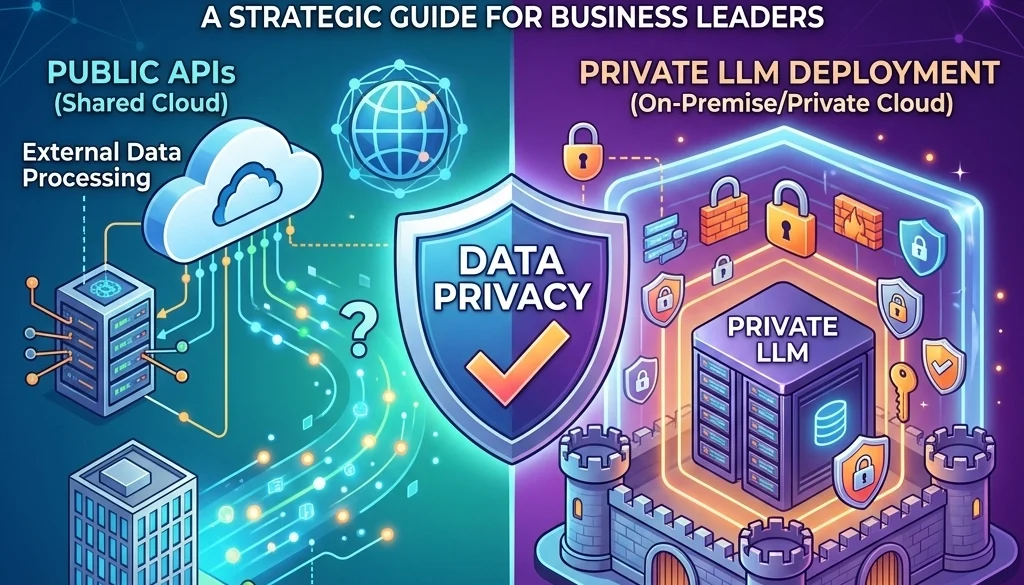
Public APIs vs. Private LLM Deployment: Which Is Better For Your Company’s Data Privacy?
Current Infrastructure Landscape
As of April 2026, corporate adoption of Large Language Models (LLMs) has transitioned from experimental usage to core operational integration. Organizations face a binary choice in architecture: consumption of Public APIs provided by third-party vendors or the execution of private llm deployment within controlled environments. This selection determines the boundary of data sovereignty and the extent of privacy risk.
Public API Architecture: Operational Mechanics
Public APIs, such as those provided by OpenAI, Google, and Anthropic, operate on a multi-tenant cloud model. Data is transmitted from the corporate client to the provider’s infrastructure for inference.
Data Transmission and Processing
- Transit: Data travels over the public internet, typically secured by TLS encryption.
- Processing: Inference occurs on hardware owned and managed by the service provider.
- Retention: Providers may retain logs, prompts, and outputs for varying durations based on service level agreements (SLAs).
Primary Privacy Risks
- Data Leakage: Proprietary code, financial projections, or sensitive customer identifiers sent via prompt become accessible to the provider.
- Model Training: Unless explicitly opted out via enterprise agreements, input data may be utilized to refine future iterations of the base model.
- Third-Party Vulnerabilities: Data security is dependent on the provider’s defensive posture. A breach at the provider level exposes all client data stored or processed within that window.

Private LLM Deployment: Technical Specifications
Private LLM deployment involves hosting open-source or licensed models within a company's own Virtual Private Cloud (VPC) or on-premises hardware. This creates a closed-loop system where data never exits the established security perimeter.
Structural Components
- Inference Servers: Dedicated compute resources (GPUs) managed by the organization or a partner like Marketrun.
- Vector Databases: Local storage of corporate knowledge used for Retrieval-Augmented Generation (RAG).
- Local Networking: Communication between the application layer and the LLM occurs within internal subnets.
Privacy Safeguards
- Isolation: Complete separation from external networks prevents unauthorized data egress.
- Zero Retention Policy: The organization dictates data logging and deletion schedules.
- Auditability: Every interaction is logged within internal systems, facilitating comprehensive forensic capabilities.
Comparative Analysis: Data Privacy and Control
| Feature | Public API | Private LLM Deployment |
|---|---|---|
| Data Ownership | Shared/Provider Access | Absolute |
| Network Egress | Required | None |
| Regulatory Compliance | Dependent on Provider | Controlled by Organization |
| Customization | Limited to System Prompts | Full Fine-tuning Capability |
| Infrastructure | Multi-tenant | Single-tenant/Isolated |
Regulatory Compliance: GDPR and HIPAA
Compliance with international and industry-specific regulations is a primary driver for custom ai solutions for smbs.
GDPR (General Data Protection Regulation)
Under GDPR, companies act as Data Controllers. Using a Public API makes the provider a Data Processor. This requires a Data Processing Agreement (DPA). If the provider processes data in a different jurisdiction (e.g., US servers for an EU company), complexities regarding "Schrems II" and international data transfers arise.
Private deployments allow for data residency. A company can ensure all PII (Personally Identifiable Information) remains within specific geographic borders, simplifying GDPR adherence. For more information on navigating these costs and regulations, refer to our guide on custom software India vs USA cost.
HIPAA (Health Insurance Portability and Accountability)
For healthcare entities, the protection of Protected Health Information (PHI) is mandatory. Public APIs often require specific "Enterprise" tiers to be HIPAA compliant, which are significantly more expensive. Private LLM deployment enables a "HIPAA-by-design" architecture. Since the data never leaves the encrypted internal environment, the risk of accidental exposure is minimized.
Strategic Implementation for SMBs
Small and Medium Businesses (SMBs) often lack the internal resources for complex AI infrastructure. Marketrun provides solutions for ai automations that bridge the gap between privacy and ease of use.
The Role of Open Source
In 2026, open-source models (such as Llama 4 or Mistral variants) rival proprietary models in specialized tasks. Self-hosting LLMs using these models eliminates recurring per-token costs associated with Public APIs.
Custom Software Integration
Privacy is not only about the model but the software surrounding it. Custom software development ensures that the AI interface, the database, and the model interact through secure protocols. Marketrun specializes in building mobile and web apps that utilize private AI backends.

Performance and Latency Considerations
While privacy is the primary focus, operational efficiency remains a factor.
- Public API Latency: Subject to internet speeds and provider load. Rate limits can throttle performance during peak hours.
- Private Deployment Latency: Dependent on allocated hardware. Localized inference typically results in lower latency for internal applications, especially when using windows software or local intranets.
Financial Analysis: API Costs vs. Infrastructure
The cost-benefit analysis of AI deployment shifted in 2026.
- API Model: Low initial cost, but high scaling costs. Every prompt incurs a fee. For high-volume businesses, monthly API bills can exceed thousands of dollars.
- Private Model: Higher initial setup and hardware/cloud costs. However, marginal cost per prompt is near zero. Over an 18-month horizon, private deployments often yield a higher AI automation ROI.
For organizations considering the transition, a detailed guide on self-hosting LLMs in 2026 provides a roadmap for infrastructure budgeting.
Security Vulnerabilities Specific to LLMs
Beyond data privacy, security includes protecting the model from manipulation.
- Prompt Injection: An attacker provides input that forces the model to ignore instructions or leak data.
- Insecure Output Handling: If the LLM output is executed as code without sanitization, it can lead to remote code execution.
Private deployments allow for the implementation of local "Guardrail" layers. These are smaller, fast models or rule-based systems that inspect inputs and outputs before they reach the user or the core LLM. This multi-layered defense is difficult to implement when relying solely on a third-party API.
Implementation Pathway
Organizations seeking to prioritize data privacy should follow a structured deployment path:
- Audit: Identify all data types intended for AI processing. Categorize by sensitivity (Public, Internal, Confidential, Restricted).
- Selection: Choose an open-source model optimized for the specific task (e.g., coding, document summarization, customer support).
- Environment Setup: Provision a VPC on a provider like AWS, Azure, or Google Cloud, or utilize offshore development for cost-efficient management.
- Deployment: Utilize containerization (Docker/Kubernetes) to deploy the inference engine.
- Integration: Connect the model to internal tools via a private API gateway.

Summary of Findings
Public APIs offer rapid prototyping and low entry barriers. However, they introduce significant data privacy risks, lack of control over data retention, and potential compliance failures.
Private LLM deployment is the superior choice for companies prioritizing data privacy. It ensures data sovereignty, facilitates adherence to GDPR and HIPAA, and provides a predictable cost structure for long-term operations. Marketrun assists businesses in this transition through open source deployment and specialized AI development services.
For further technical insights into AI agents and automation, consult our 2026 guide. To discuss a specific private deployment for your organization, visit our solutions page.