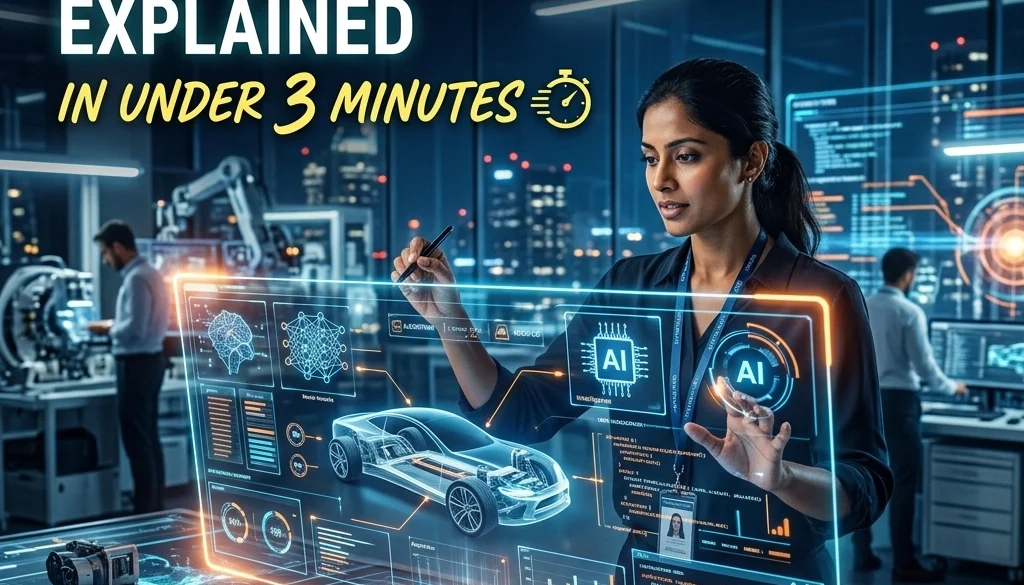
The Future of AI-Driven Engineering Explained in Under 3 Minutes
Executive Summary: Engineering Paradigm Shift
The engineering sector is undergoing a transition from manual iterative cycles to autonomous optimization. This shift is driven by the integration of artificial intelligence into core design and production workflows. In 2026, the reliance on human-led hypothesis testing has decreased. Data-driven models now dictate the parameters of structural, mechanical, and software engineering.
AI Agents for Business Logic and Engineering Automation
The deployment of ai agents for business is a primary indicator of this shift. These agents function as autonomous units capable of managing complex engineering tasks.
Functional Capabilities of AI Agents
- Code Generation and Refinement: AI agents utilize Large Language Models (LLMs) to write, debug, and optimize software code. This process reduces the time required for development cycles.
- Requirement Analysis: Agents parse technical documentation to extract specifications and identify potential conflicts in design.
- Task Orchestration: Multiple agents coordinate to manage hardware and software integration without human intervention.
For organizations seeking to implement these systems, information is available at Marketrun AI Automations.

Generative Design and Simulation
Generative design utilizes algorithms to explore every possible permutation of a solution. Engineers input constraints: such as material type, weight limits, and budget: and the AI generates optimal geometries.
Simulation Efficiency
Traditional Finite Element Analysis (FEA) and Computational Fluid Dynamics (CFD) require significant computational time. AI models now provide real-time predictions by utilizing historical data points.
- Latency Reduction: Computation times have been reduced from hours to milliseconds.
- Optimization: Systems identify structural efficiencies that are non-intuitive to human observers.
The integration of these tools into custom software allows for the creation of specialized engineering platforms tailored to specific industrial needs.
Custom AI Solutions for SMBs
Small and Medium Businesses (SMBs) are adopting specialized AI to compete with larger enterprises. Custom ai solutions for smbs focus on high-impact areas where resource constraints are most prevalent.
Implementation Areas for SMBs
- Supply Chain Optimization: AI predicts fluctuations in material costs and identifies alternative vendors.
- Automated Quality Control: Computer vision systems detect defects in manufactured parts with higher accuracy than human inspectors.
- Energy Management: Algorithms monitor facility usage to reduce operational expenditures.
Marketrun provides these specialized tools through AI Development services, ensuring that smaller firms maintain technological parity.

Predictive Maintenance and System Reliability
Engineering focus has shifted from reactive repair to predictive reliability. Sensors and IoT devices feed data into machine learning models to monitor the health of physical assets.
Maintenance Indicators
- Vibration Analysis: Detection of deviations in motor or turbine frequencies.
- Thermal Imaging: Monitoring of heat signatures to identify electrical resistance or friction.
- Acoustic Monitoring: Identification of bearing failures through sound pattern recognition.
The application of these systems results in increased uptime for infrastructure and manufacturing lines. Detailed guides on the ROI of such implementations are available in the Marketrun Blog.
Digital Twins and Virtual Prototyping
A digital twin is a virtual representation of a physical object or system. It serves as the bridge between the physical and digital worlds.
Utilization of Digital Twins
- Stress Testing: Systems are subjected to extreme conditions in a virtual environment to determine failure points.
- Lifecycle Monitoring: The twin tracks the wear and tear of its physical counterpart over time.
- Operational Training: Personnel use digital twins for training without risking damage to actual hardware.
The hosting of these complex models often requires self-hosting LLMs to ensure data privacy and low-latency access to the underlying logic.

Software Engineering and Autonomous Development
The decade of 2026-2036 is characterized by the rise of autonomous software development. Marketrun’s vision involves a future where software builds itself based on high-level objectives.
Development Tiers
- Level 1: Assisted Coding: AI suggests snippets and corrects syntax errors.
- Level 2: Module Generation: AI creates entire functional modules based on prompts.
- Level 3: Full Autonomy: AI agents design the architecture, select the stack, and deploy the application.
This evolution is particularly evident in the creation of mobile and web apps, where standard patterns are now fully automated.
Economic Impact and Global Delivery
The cost structures of engineering have changed. The disparity between local and offshore development is being bridged by AI productivity gains.
Cost Analysis
| Component | Traditional Engineering (2020) | AI-Driven Engineering (2026) |
|---|---|---|
| Labor Hours | High | Low |
| Error Rate | Variable | Minimal |
| Scalability | Linear | Exponential |
Marketrun manages these global shifts for both US clients and India clients, focusing on cost-efficient delivery of high-complexity software.

Infrastructure and Deployment Strategies
The future of AI-driven engineering is dependent on underlying infrastructure. The move toward open source deployment allows companies to retain control over their intellectual property.
Deployment Preferences
- Cloud-Native: Utilization of scalable cloud resources for heavy training tasks.
- Edge Computing: Deployment of AI models directly on sensors for immediate decision-making.
- Hybrid Hosting: Balancing sensitive data on-site while using public clouds for general processing.
For a deeper technical understanding of these structures, refer to the AI Agents and Automations Guide 2026.
The Human-AI Symbiosis
Engineering roles are transitioning. The engineer of 2026 functions as a system architect and objective setter rather than a manual calculator.
Role Evolution
- Prompt Engineering: Mastery of communicating objectives to AI systems.
- Audit and Compliance: Ensuring AI-generated designs meet safety and legal standards.
- Strategic Oversight: Defining the "why" and "what" while the AI determines the "how."
Conclusion of Systems Overview
The future of engineering is characterized by the removal of manual friction. Through ai agents for business and custom ai solutions for smbs, Marketrun facilitates this transition. The objective is the delivery of high-precision, low-cost engineering solutions at scale.
Detailed pricing for these implementation services is listed at Marketrun Pricing. Information regarding website creation and SEO integration is available at AI Website Creation and AI Website SEO 2026.