The Ultimate Guide to AI Automation Workflows: Everything You Need to Succeed in 2026
Abstract
AI automation workflows define the systematic integration of artificial intelligence into business processes. In 2026, these workflows prioritize agentic capabilities, enabling autonomous decision-making across disparate software ecosystems. This guide details the architecture, implementation phases, and technical requirements to automate business operations with AI.
Core Definition of AI Automation Workflows
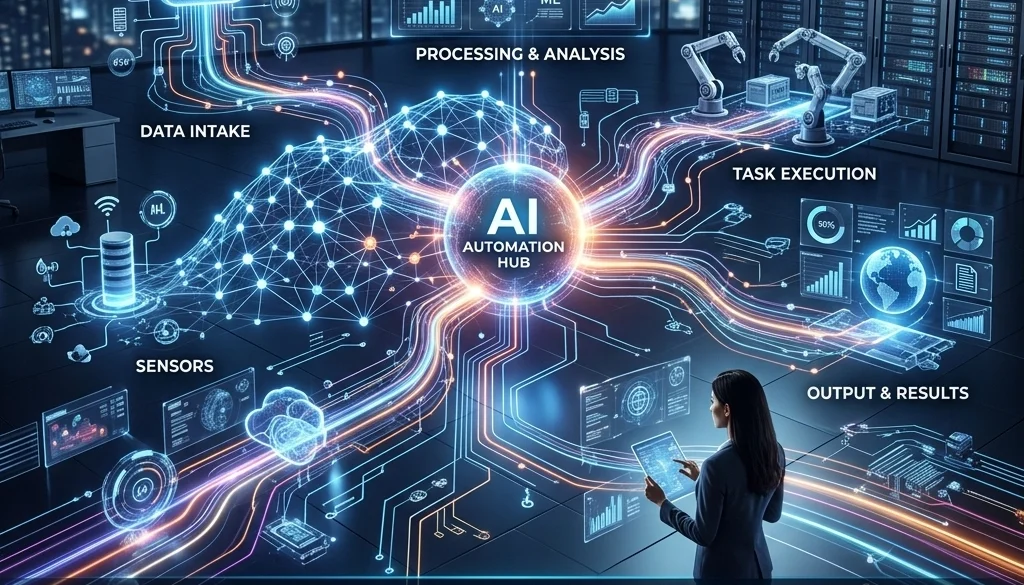
An AI automation workflow is a sequence of tasks where artificial intelligence executes logic, processes data, or generates output without manual intervention. Unlike legacy automation, which relies on fixed "if-then" logic, AI workflows utilize Large Language Models (LLMs) and Machine Learning (ML) to handle unstructured data and variable scenarios.
Current systems focus on:
- Autonomous Agents: Independent units performing multi-step tasks via API.
- Contextual Processing: Understanding the intent behind data inputs.
- Self-Healing Logic: Identifying and correcting errors within the workflow sequence.

Six-Step Implementation Framework
The deployment of effective AI automation workflows requires a structured approach to ensure technical stability and operational return on investment.
Step 1: Use Case Identification
Operational bottlenecks provide the primary basis for automation. High-volume, repetitive tasks with digital inputs are prioritized.
- Criteria: Frequency of task, error rate in manual execution, and availability of training data.
- Typical Candidates: Document extraction, lead scoring, customer support routing, and automated reporting.
Step 2: Process Mapping and Logic Design
Visualizing the current state allows for the identification of decision nodes.
- Inputs: CRM data, emails, webhooks, or database entries.
- Decision Nodes: Points where AI must choose a path based on context.
- Outputs: Updated records, generated content, or triggered notifications.
Step 3: Data Preparation and Governance
AI performance correlates with data quality. Data must be cleaned, structured, and accessible.
- Normalization: Standardizing formats across systems.
- Accessibility: Ensuring secure API access to necessary data silos.
- Compliance: Mapping data flows to meet regional regulations like GDPR or CCPA.

Step 4: Model and Tool Selection
The choice of technology depends on the complexity of the reasoning required.
- Simple Tasks: Rule-based logic with minimal AI intervention.
- Reasoning Tasks: Integration of LLMs (e.g., GPT-4o, Claude 3.5) for text and decision-making.
- Specialized Tasks: Custom ML models for predictive analytics.
Platforms like Marketrun AI Automations provide infrastructure for these deployments.
Step 5: Integration and Orchestration
Connecting disparate systems is the central challenge in AI automation.
- API Management: Utilizing REST or GraphQL to facilitate communication between software.
- Middleware: Using platforms such as Make, Zapier, or custom Python scripts to bridge gaps.
- Human-in-the-Loop (HITL): Implementing checkpoints where human approval is required for high-stakes decisions.
Step 6: Monitoring and Optimization
Post-deployment performance must be tracked against predefined Key Performance Indicators (KPIs).
- Latency: Time taken for the AI to process an input.
- Accuracy: Frequency of correct outputs versus manual review findings.
- Cost-per-Execution: The operational expense of API tokens and compute power.
Connecting Disparate Systems to Automate Business Operations
To automate business operations with AI effectively, a unified data layer must exist across separate platforms. Business operations often reside in silos: sales in CRM, finance in ERP, and communication in Slack or Email.
Methods of Integration
- Native Integrations: Direct connections provided by SaaS vendors.
- Webhooks: Real-time data transmissions triggered by specific events.
- Custom Middleware: Custom software development to create bespoke connectors for legacy systems.
- RPA (Robotic Process Automation): Used for legacy applications lacking modern APIs.

Advanced AI Automation Tips for 2026
Success in 2026 requires moving beyond simple linear automations.
1. Implementation of Agentic Workflows
Agents are designed to act independently to achieve a goal. Instead of a fixed sequence, an agent determines the necessary steps based on the current environment. This is critical for complex AI development projects.
2. Multi-Model Chaining
Using a single model for all tasks is inefficient.
- Use small, fast models (e.g., GPT-4o-mini) for categorization.
- Use large, reasoning-heavy models (e.g., GPT-4o) for final output generation.
- This strategy optimizes token usage and reduces latency.
3. Prompt Engineering and Version Control
Prompts must be treated as code.
- Versioning: Tracking changes to prompts to identify performance regressions.
- Dynamic Prompting: Injecting real-time data into prompt templates to provide context.
4. Self-Hosting for Privacy and Performance
Enterprises with strict data requirements should consider self-hosting LLMs. This eliminates third-party data residency issues and can reduce long-term operational costs for high-volume workflows.

Tooling Matrix: 2026 Landscape
Selecting the correct toolset is dependent on the technical proficiency of the team and the scale of the operation.
| Category | Recommended Tools | Ideal Use Case |
|---|---|---|
| No-Code/Low-Code | Zapier, Make, Bardeen | Rapid prototyping and simple cross-app triggers. |
| Pro-Code/Orchestration | n8n, LangChain, CrewAI | Complex agentic workflows and backend integration. |
| Enterprise Grade | Workato, Tray.ai | Large-scale operations requiring high security and SLAs. |
| Custom Solutions | Marketrun Solutions | Bespoke AI agents and custom software integration. |
Strategy for Scalability
Automation should begin with a pilot program. Scaling too early leads to compounded errors.
The Pilot Phase
- Scope: One specific department (e.g., Customer Success).
- Timeline: 2-4 weeks.
- Goal: Validate that the AI workflow saves a minimum of 20% of manual labor time.
The Expansion Phase
Once the pilot is successful, the logic is replicated across other departments. Centralized governance ensures that all AI automation workflows follow the same security and data protocols. For companies operating across borders, understanding the cost differences between India and USA can influence the budget allocation for large-scale scaling.

ROI Analysis of AI Workflows
Calculating the Return on Investment is necessary for continued stakeholder support.
- Labor Savings: (Manual hours previously required) x (Hourly rate).
- Error Reduction: Savings from avoided rework or compliance fines.
- Revenue Acceleration: Faster response times leading to higher conversion rates.
Marketrun provides an AI Automation ROI Calculator to assist in these projections.
Technical Maintenance and Evolution
AI workflows are not static. Models are updated, and third-party APIs change.
- Scheduled Audits: Monthly reviews of workflow logic and model performance.
- Shadow Testing: Running new model versions in parallel with the production version to compare results.
- Feedback Loops: Allowing end-users to flag incorrect AI outputs to retrain or refine prompts.
Conclusion on Systemic Efficiency
Automation is a prerequisite for competitiveness in 2026. By building robust AI automation workflows, organizations transition from manual task management to strategic oversight. The integration of AI into core business operations reduces operational friction and enables data-driven decision-making at scale.
For organizations seeking to implement these systems, Marketrun offers specialized services in AI and Custom Software Development. Review our pricing or contact our teams for US clients and India clients to begin implementation.