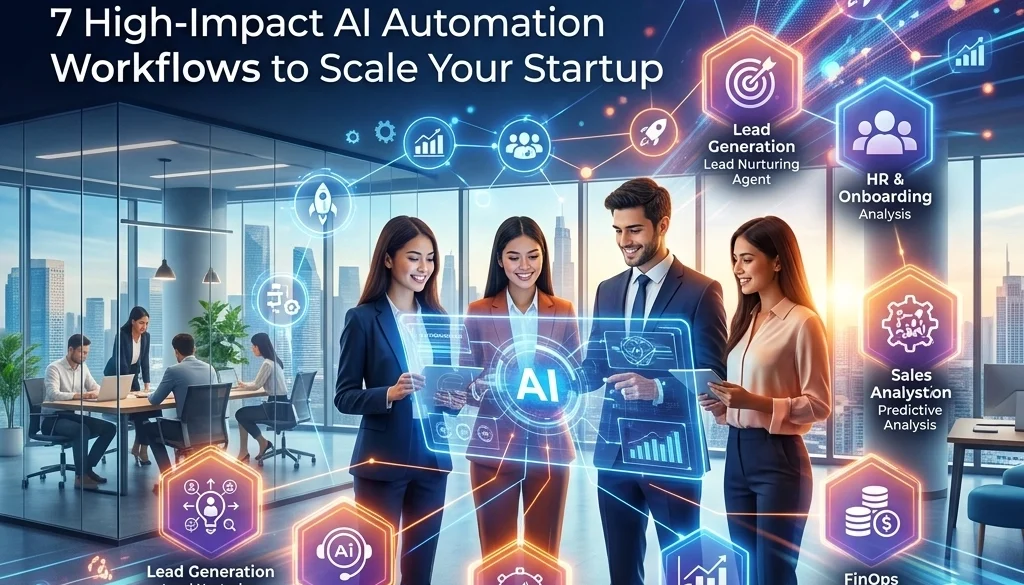
AI Agents for Business: 7 High-Impact AI Automation Workflows to Scale Your Startup
Operational Overview: AI Automation and Startup Scalability
Startups utilize AI automation workflows to execute repetitive tasks without manual intervention. AI agents for business function as autonomous software units capable of reasoning, planning, and executing sequences of actions across multiple platforms. Implementation of these systems typically results in a reduction of 10 to 20 labor hours per week for small and medium-sized businesses (SMBs). Tools such as n8n provide the orchestration layer required to connect diverse APIs with Large Language Models (LLMs).
1. Automated Lead Scoring and CRM Enrichment
Manual lead qualification is time-intensive. This workflow automates the intake and evaluation of potential clients.
- Process: A new lead submits a form via a website.
- Action: An n8n workflow triggers an AI agent to research the lead’s company via public LinkedIn profiles and website metadata.
- Outcome: The AI agent assigns a lead score based on predefined Ideal Customer Profile (ICP) criteria and updates the CRM.
- Benefit: Sales teams focus exclusively on high-probability conversions.

2. 24/7 Intelligent Customer Support Triaging
Customer support efficiency is maintained through automated classification and response.
- Process: An incoming query is received via email or chat.
- Action: The AI agent analyzes the sentiment and intent. It retrieves relevant documentation from an internal knowledge base.
- Outcome: The agent provides a direct resolution for common issues or escalates complex tickets to human personnel with a summarized history.
- Integration: Deployment via marketrun.io/solutions/ai-automations ensures seamless connectivity with existing support stacks.
3. Multi-Channel Content Repurposing
Marketing scalability is achieved through the automated transformation of core content assets.
- Process: A long-form blog post or video transcript is uploaded to a shared drive.
- Action: AI agents extract key insights, generate social media captions for various platforms (X, LinkedIn, Instagram), and format them for scheduling.
- Outcome: A single content piece is distributed across five channels within minutes.
- Efficiency: Eliminates the need for manual copy drafting for social distribution.
4. Automated Financial Operations and Invoice Processing
Financial accuracy is maintained through optical character recognition (OCR) and AI-driven categorization.
- Process: Invoices are received in a dedicated inbox.
- Action: AI agents extract vendor names, dates, amounts, and line items.
- Outcome: Data is validated against purchase orders and synchronized with accounting software like QuickBooks or Xero.
- Risk Mitigation: Reduction of human data-entry errors in accounts payable.

5. Meeting Summarization and Action Item Extraction
Internal communication is streamlined by converting synchronous meetings into asynchronous documentation.
- Process: Meeting audio is recorded and transcribed.
- Action: An AI agent parses the transcript to identify decisions made and tasks assigned to specific team members.
- Outcome: A summary and task list are automatically posted to project management tools such as Notion or Jira.
- Time Saved: Employees bypass manual note-taking and follow-up drafting.
6. Competitive Intelligence and Market Monitoring
Strategic positioning is supported by continuous data collection and analysis.
- Process: AI agents monitor competitor websites, pricing pages, and news feeds.
- Action: Changes in pricing or product features are detected and summarized weekly.
- Outcome: Management receives a structured report on market shifts.
- Tooling: This utilizes self-hosting LLMs for private data processing.
7. Personalized Cold Outreach at Scale
Outbound sales efforts are enhanced through data-driven personalization.
- Process: A list of target prospects is identified.
- Action: The AI agent reviews recent prospect activity or company news.
- Outcome: A customized introductory email is generated, referencing specific details to increase open and response rates.
- Scalability: High-volume outreach is maintained without sacrificing message quality.

Infrastructure: The Role of n8n and AI Orchestration
Effective AI automation workflows require a centralized orchestration platform. n8n is an open-source workflow automation tool that allows for complex logic, branching, and error handling. Unlike basic automation tools, n8n supports the integration of "AI Agent" nodes. These nodes allow for the inclusion of specific instructions (System Prompts) and memory, enabling the agent to maintain context over long-running processes.
For startups prioritizing data security and cost-efficiency, self-hosting LLMs integrated with n8n is the preferred architecture. This configuration prevents sensitive business data from leaving controlled environments while eliminating the per-token costs associated with proprietary API models.
Impact on Business ROI
The implementation of these 7 workflows yields measurable returns on investment. By delegating low-level cognitive tasks to AI agents for business, human capital is redirected toward high-value activities such as product development and strategic relationship management.
Typical ROI Metrics:
- Labor Savings: 40–80 hours per month across the organization.
- Response Time: Reduction from hours to seconds for customer and lead interactions.
- Accuracy: Elimination of manual transcription and data entry errors.
Detailed calculations can be performed using the Marketrun AI ROI Calculator.
Strategic Implementation
Startups should follow a phased approach to AI automation:
- Identify: Document existing repetitive processes.
- Prototype: Build a minimum viable workflow in n8n for a single department.
- Validate: Measure time savings and error rates.
- Scale: Deploy additional workflows across the organization.
Marketrun provides comprehensive support for these transitions, ranging from custom software development to specialized AI development.
Deployment Considerations for US and India Markets
Operational costs and technical requirements vary by region. Startups operating in the US often focus on labor cost reduction, while those in India prioritize rapid scaling and international service delivery. Marketrun offers tailored solutions for both US clients and India-based clients, ensuring regional compliance and optimal infrastructure performance.
For further information on integrating these systems into existing business structures, refer to the comprehensive guide on AI agents and automations.