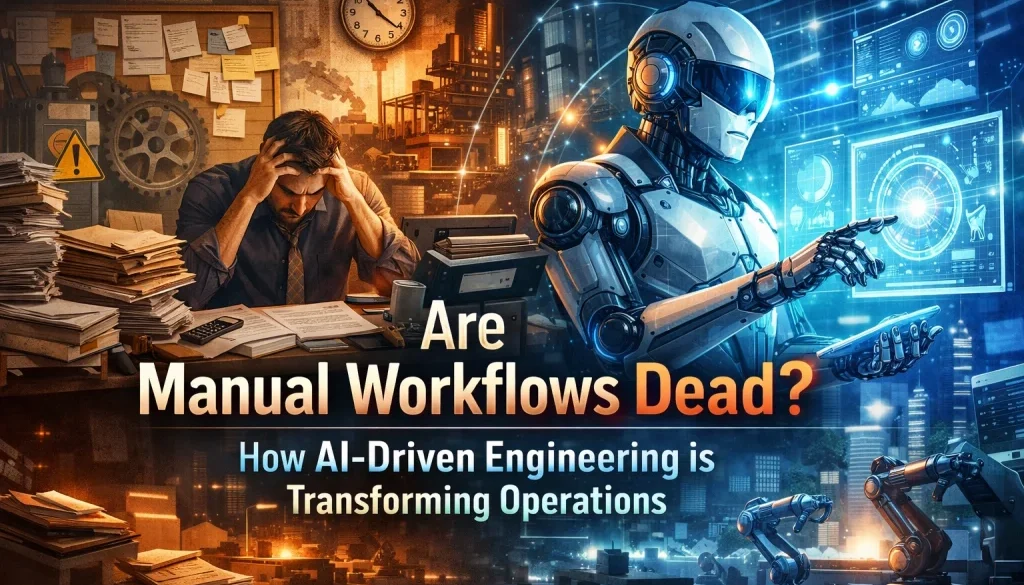
Are Manual Workflows Dead? How AI-Driven Engineering is Transforming Operations
Current Operational Status: Manual Workflows
Manual workflows are characterized by human-dependent execution of repetitive tasks. Data indicates that 60% of professional functions are subject to automation. Current benchmarks show that employees allocate approximately one hour per day to repetitive administrative maintenance. This results in 250 hours of lost productivity per annum per employee.
The utilization of manual processes introduces variables that impede operational consistency. These variables include data entry errors, decision-making latency, and lack of horizontal scalability. Marketrun identifies these factors as primary contributors to technical debt within small and medium-sized businesses (SMBs).
Inefficiency Metrics and Technical Debt
Operational bottlenecks are quantifiable. Manual invoice processing, for instance, requires high temporal investment compared to automated alternatives. Organizations utilizing manual entry report higher error rates and increased overhead costs. The reliance on legacy spreadsheets and unintegrated file transfers creates data silos.
Technical debt accumulates when temporary manual workarounds are used instead of structured engineering solutions. As data volumes increase, these manual systems fail to maintain required throughput. The transition to custom software solutions is a prerequisite for maintaining market parity in the 2026 fiscal environment.

AI-Driven Engineering: Definition and Scope
AI-driven engineering refers to the integration of machine learning models and autonomous logic into the software development lifecycle and business operations. It differs from basic automation by utilizing probabilistic reasoning and contextual awareness.
The implementation of ai agents for business enables the execution of complex logic sequences without human intervention. These agents interact with existing APIs, databases, and third-party services to perform tasks such as lead qualification, inventory management, and customer support triage.
Integration of AI Agents for Business
AI agents are deployed to handle specific operational domains. The architecture of these agents involves:
- Perception Layer: Monitoring data inputs from various channels.
- Reasoning Layer: Utilizing Large Language Models (LLMs) to determine the necessary actions.
- Action Layer: Executing functions within the business software environment.
For SMBs, the deployment of custom ai solutions for smbs targets specific friction points. Examples include the automated synchronization of CRM data and the generation of financial reports based on real-time transaction streams.
Custom AI Solutions for SMBs: Implementation and ROI
The ROI of AI automation is calculated by comparing the cost of deployment against the reduction in labor hours and error-related losses. Detailed analysis is available via the AI automation ROI calculator.
SMBs often require specific configurations that off-the-shelf products do not provide. Custom engineering ensures that AI models are trained on proprietary data while maintaining security protocols. This includes the option for self-hosting LLMs, which provides data sovereignty and reduces long-term subscription costs.

Transformation of Software Development at Marketrun
The methodology for software creation has shifted. Engineering now prioritizes the creation of self-healing systems and autonomous code generation. Marketrun’s vision for the next decade focuses on:
- Autonomous Infrastructure: Systems that scale and repair without manual oversight.
- Generative User Interfaces: Web and mobile apps that adapt to user behavior in real-time.
- Open Source Deployment: Utilizing open source deployment to reduce licensing fees and increase transparency.
This shift reduces the time-to-market for mobile and web apps. Engineering resources are redirected from maintenance to the development of core business logic.
Comparative Analysis: Manual vs. AI-Driven Operations
| Feature | Manual Workflows | AI-Driven Engineering |
|---|---|---|
| Execution Speed | Dependent on human availability | Real-time, 24/7 |
| Error Rate | High (Human factor) | Low (Rule-based/Probabilistic) |
| Scalability | Linear (Requires more staff) | Exponential (Requires more compute) |
| Data Utilization | Post-facto analysis | Real-time predictive insights |
| Maintenance | Continuous labor requirement | Initial setup and periodic tuning |
The data suggests that manual workflows are not dead but are objectively obsolete for high-growth objectives. The transition to ai automations is a standard requirement for operational modernization.
Regional Engineering Logistics: India and USA
The global engineering landscape allows for strategic resource allocation. Marketrun facilitates development for both US clients and India clients. A detailed comparison of the cost structures and benefits is documented in the custom software India vs USA cost guide.
Offshore development models have evolved. The focus is no longer just on labor arbitrage but on accessing specialized talent in AI and machine learning. High-quality output is maintained through standardized engineering protocols and integrated project management.

Security and Deployment Considerations
Security is a primary constraint in AI adoption. Reliance on public cloud models can expose sensitive data. Marketrun provides solutions for self-hosting LLMs 2026 guide to mitigate these risks. Private infrastructure ensures that proprietary business logic remains internal.
Furthermore, the deployment of Windows software and cross-platform applications requires rigorous security testing. AI-driven engineering includes automated security audits and vulnerability patching as part of the continuous integration pipeline.
The Future of AI and Engineering: A 10-Year Trajectory
The next decade will see the total integration of AI into the underlying architecture of all business software. The distinction between "software" and "AI" will cease to exist.
- Phase 1 (Current): Integration of AI agents into manual workflows.
- Phase 2 (2027-2030): Predominance of autonomous agents managing end-to-end business units.
- Phase 3 (2030-2035): Self-evolving software systems that modify their own codebases based on performance metrics.
Marketrun focuses on preparing SMBs for this trajectory through scalable AI development.
Summary of Marketrun Resources
Access to specialized documentation and tools is required for transition planning:
- AI agents and automations guide
- Offshore web and mobile apps guide
- AI website and SEO trends 2026
- Service Pricing
Manual workflows are replaced by engineered systems. Efficiency is the outcome of strategic AI deployment.

Detailed operational audits and implementation strategies are available through Marketrun.