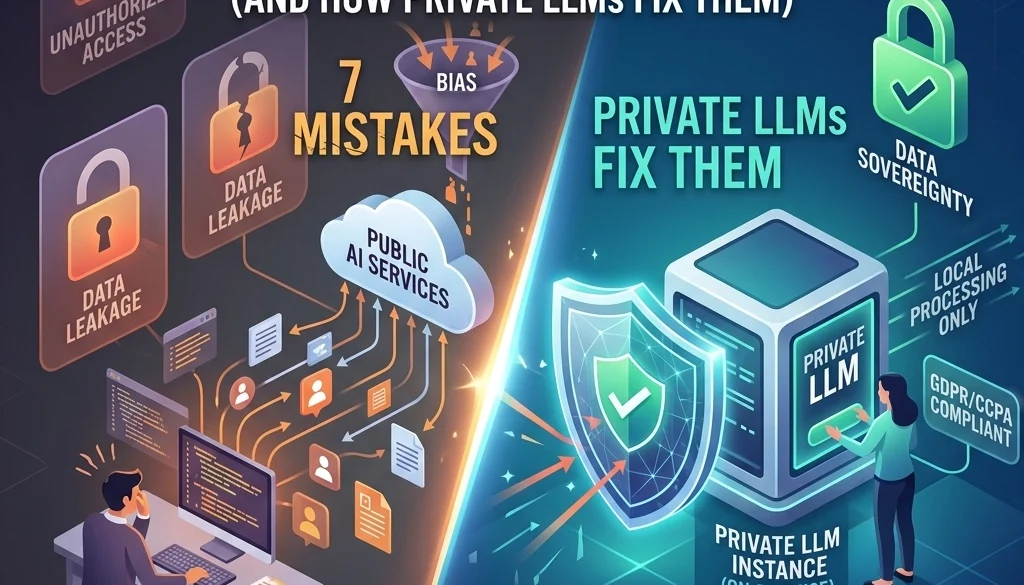
7 Mistakes You’re Making with AI Data Privacy (And How Private LLMs Fix Them)
DATA PRIVACY STATUS: CRITICAL ANALYSIS
Artificial intelligence integration within business operations introduces specific vulnerabilities regarding data integrity and confidentiality. Current enterprise reliance on public Large Language Model (LLM) providers creates exposure vectors that deviate from established regulatory standards.
IDENTIFIED ERROR 1: TRANSMISSION OF SENSITIVE DATA TO PUBLIC CLOUD APIS
Organizations utilize public endpoints (e.g., OpenAI, Anthropic, Google) to process proprietary information. This data leaves the controlled internal environment.
- Risk: Data persists on external servers.
- Impact: Loss of exclusive control over intellectual property.
- Solution: Private LLM deployment ensures all data remains within a local or virtual private cloud (VPC) environment.
When a prompt contains source code, financial projections, or legal contracts, the provider receives this information. Even with "enterprise" agreements, the physical transit of data over the internet represents a surface for interception. Local hosting eliminates the transit risk.

IDENTIFIED ERROR 2: NON-COMPLIANCE WITH GEOGRAPHIC DATA RESIDENCY REQUIREMENTS
Public AI providers often utilize distributed server networks. Data residency for GDPR (Europe) or specific regional mandates (India, USA) is frequently ignored during API calls.
- Observation: Data processed by public LLMs may move across international borders without explicit authorization.
- Result: Violation of Article 44 of the GDPR.
- Mitigation: Self-hosting LLMs allows for the selection of specific server locations.
By utilizing custom AI solutions for SMBs, a company dictates the physical coordinates of the hardware processing the data. This is essential for entities operating under the Digital Personal Data Protection Act (DPDP) in India or CCPA in the United States. For more information on regional compliance, refer to Marketrun for US Clients or Marketrun for India Clients.
IDENTIFIED ERROR 3: DATA INCLUSION IN MODEL TRAINING SETS
Public AI models utilize user inputs to improve future iterations. This process is often enabled by default in consumer-grade interfaces.
- Mechanism: Inputs are vectorized and stored for reinforcement learning from human feedback (RLHF).
- Outcome: Proprietary logic or sensitive customer data may be reproduced in responses to third-party users.
- Fix: Implementation of an open-source deployment prevents external model training.
Private LLMs use weights that are static or updated only through internal fine-tuning. There is no feedback loop back to the original model creators (e.g., Meta, Mistral, or OpenAI).

IDENTIFIED ERROR 4: EMPLOYEE "SHADOW AI" USAGE
Employees frequently utilize unauthorized AI tools to increase productivity. This bypasses corporate security protocols and monitoring.
- Frequency: High.
- Data Involved: Passwords, customer PII, internal strategy documents.
- Remedy: Deployment of centralized AI automations via an internal interface.
Providing a secure, company-sanctioned AI portal reduces the incentive for employees to use external, unmonitored tools. Centralized management via custom software ensures that every interaction is logged and filtered according to internal governance policies.
IDENTIFIED ERROR 5: LACK OF GRANULAR AUDIT TRAILS
Public AI providers offer limited visibility into how data is accessed internally by their personnel or automated systems.
- Deficiency: Inability to produce detailed access logs for compliance audits (HIPAA/SOC2).
- Consequence: Failure of security audits and loss of certification.
- Solution: Private infrastructure provides full access to logs, including timestamped prompt records and token usage statistics.
Organizations requiring high levels of transparency must maintain the hardware and software stack. This is particularly relevant for mobile and web apps that handle medical or financial data.
IDENTIFIED ERROR 6: INSUFFICIENT DATA MINIMIZATION
Public APIs often require the submission of large context windows to maintain conversational coherence. This results in more data being shared than is strictly necessary for the task.
- Analysis: Over-sharing occurs due to a lack of pre-processing filters.
- Technique: Local RAG (Retrieval-Augmented Generation) systems.
- Application: Private LLMs integrate with local databases to fetch only the relevant data chunks.
By using local AI development practices, data is scrubbed of PII before it reaches the inference engine. This architectural choice adheres to the principle of data minimization.

IDENTIFIED ERROR 7: RELIANCE ON THIRD-PARTY UPTIME AND RATE LIMITS
Operational security includes availability. Dependence on external APIs introduces systemic risk related to provider outages or changes in terms of service.
- Risk: Business continuity disruption.
- Fix: Local inference on dedicated hardware.
Private LLMs provide deterministic performance and 100% availability, provided the internal infrastructure is maintained. This is a critical component of AI website creation and automated customer support systems where downtime results in direct revenue loss.
TECHNICAL SOLUTION: THE PRIVATE LLM ARCHITECTURE
The transition from public APIs to private deployments involves specific infrastructure requirements. This shift moves the organization from a "Tenant" model to an "Owner" model.
HARDWARE SPECIFICATIONS FOR LOCAL DEPLOYMENT
For effective inference, the following hardware parameters are monitored:
- VRAM (Video RAM): Essential for loading model parameters. Large models (70B+) require 48GB to 80GB of VRAM.
- Compute Units: NVIDIA H100 or A100 GPUs are the current industry standard.
- Local Storage: High-speed NVMe drives for quick model loading and vector database access.
SOFTWARE STACK
The deployment utilizes open-source frameworks such as:
- vLLM: For high-throughput serving.
- Ollama: For local development and testing.
- Text-Generation-WebUI: For administrative interfaces.
Further details are available in the Self-Hosting LLMs 2026 Guide.
COMPLIANCE MAPPING: PUBLIC VS. PRIVATE
| Requirement | Public API (Standard) | Private LLM Deployment |
|---|---|---|
| Data Residency | Provider-defined | User-defined |
| GDPR Compliance | Complex/Dependent | Direct Control |
| HIPAA Alignment | Requires BAA (often expensive) | Inherently compatible via air-gapping |
| Model Training | Risk of data leakage | Zero leakage |
| Audit Logs | Limited | Comprehensive |
OPERATIONAL COSTS AND ROI
While initial setup costs for private LLMs involve hardware acquisition or reserved cloud instances, the long-term ROI is positive for high-volume users.
- Elimination of Token Fees: No per-request billing.
- Predictable Expenses: Fixed monthly infrastructure costs.
- Reduced Legal Risk: Lower probability of data breach penalties.
Calculate potential savings using the AI Automation ROI Calculator.

DEPLOYMENT STRATEGY FOR SMBS
Small and Medium Businesses (SMBs) must adopt a phased approach to AI privacy.
PHASE 1: AUDIT
Identify all points where data currently interfaces with external AI. Review current pricing models of public providers to determine cost-efficiency.
PHASE 2: PROTOTYPING
Deploy a small-scale private model (e.g., Mistral 7B or Llama 3 8B) for internal tasks. This allows for the testing of AI agents and automations without exposing live client data.
PHASE 3: SCALING
Move critical production workloads to private infrastructure. For businesses operating across borders, consider the cost implications of Offshore Web and Mobile Apps.
CONCLUSION
Data privacy in the age of AI is a technical requirement, not a secondary feature. The mistakes associated with public LLM usage: data exposure, residency violations, and lack of control: are mitigated through the adoption of private, locally hosted models.
Marketrun provides the expertise to transition from vulnerable public interfaces to secure, custom-built AI environments. Explore Windows Software solutions or consult our Blog for further technical documentation.
SYSTEM STATUS: SECURE
- Data Location: Local
- Encryption: Enabled (AES-256)
- Compliance: HIPAA/GDPR Verified
- Model: Private Instance
For organizations seeking to implement these solutions, the AI website and SEO guide provides additional context on integrating private AI into public-facing digital assets safely.