Do You Really Need SaaS? The Truth About Self-Hosted Open Source Tools
Infrastructure paradigms: SaaS vs. Self-Hosting
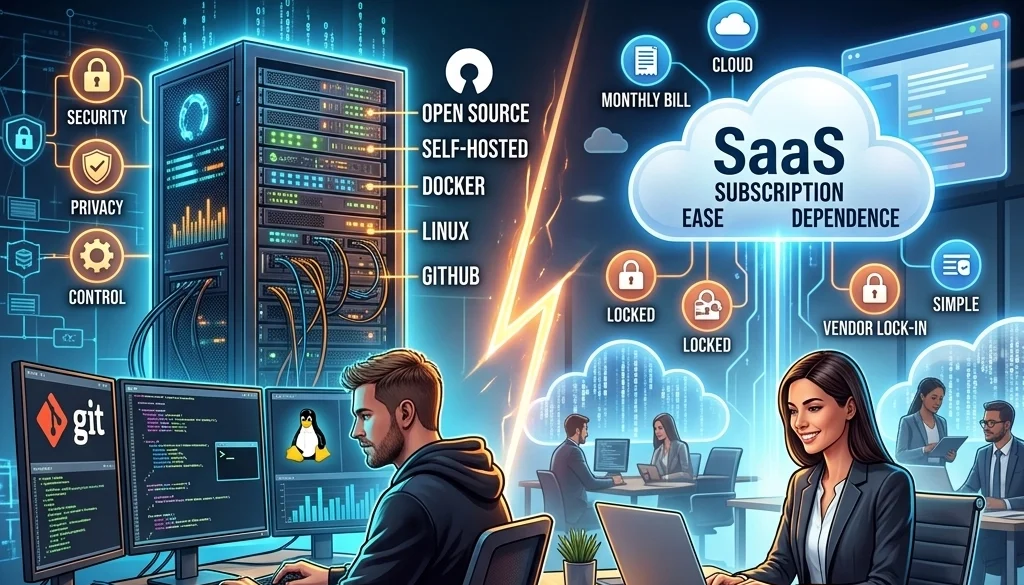
The current software landscape is bifurcated into Software-as-a-Service (SaaS) and self-hosted deployments. SaaS involves the consumption of applications hosted on third-party infrastructure. Self-hosting involves the installation and management of software on private servers or virtual private clouds (VPC).
SaaS models prioritize immediate availability and outsourced maintenance. Self-hosted open source tools prioritize data sovereignty, customization, and long-term cost containment. The selection between these paradigms depends on operational requirements, technical capacity, and data sensitivity.
Core attributes of self-hosted open source tools
Self-hosted open source tools are defined by the availability of source code and the right to execute the software on independent hardware.
Data Sovereignty
Data sovereignty is the principle that digital data is subject to the laws and governance of the country or organization where it is located. SaaS models require data to be transmitted to and stored on external servers. Self-hosting ensures that data remains within the organizational perimeter.
Customization and Extensibility
Open source codebases allow for direct modification. Organizations can alter the functionality of the software to align with specific workflows. This is not possible with proprietary SaaS platforms, which offer fixed feature sets and limited API access.
Software Ownership
Ownership is established through the possession of the software binary and the environment it resides in. In a SaaS model, access to the software is a temporary license. If the provider terminates the service or modifies pricing structures, the user has limited recourse.

Analysis of Key Open Source Technologies
Three specific technologies represent the efficacy of the self-hosted model in 2026: Supabase, n8n, and Ollama.
Supabase: The Backend Alternative
Supabase is an open-source alternative to Firebase. It provides a suite of tools including a PostgreSQL database, authentication, real-time subscriptions, and storage.
- Database: PostgreSQL remains the core component, offering relational data management.
- Self-hosting: Supabase can be deployed using Docker on private infrastructure.
- Benefit: Full control over database performance tuning and backup schedules is maintained.
n8n: Workflow Automation
n8n is a fair-code licensed workflow automation tool. It serves as a self-hosted alternative to Zapier or Make.
- Deployment: The software is frequently deployed via n8n deployment services to ensure high availability.
- Capability: It supports over 400 integrations and allows for custom JavaScript nodes.
- Security: Sensitive API keys and credentials never leave the internal network.
Ollama: Local LLM Execution
Ollama is a tool for running large language models (LLMs) locally.
- Functionality: It enables the execution of models such as Llama 3 or Mistral on local hardware.
- AI Development: Developers utilize Ollama for ai development without incurring per-token costs from external API providers.
- Privacy: Model inference occurs locally, preventing the exposure of proprietary prompts to third-party AI companies. Information on this is available in the self-hosting llms 2026 guide.

Elimination of Vendor Lock-in
Vendor lock-in occurs when the cost of switching from a provider is high enough to force continued usage.
Proprietary Data Formats
SaaS providers often utilize proprietary data structures. Exporting data from these systems can result in data loss or require extensive transformation. Self-hosted tools typically use standard formats like SQL or JSON.
Pricing Volatility
SaaS pricing is subject to unilateral changes by the provider. Subscription costs often increase as usage scales. Self-hosted open source tools maintain a flat cost structure related to infrastructure consumption rather than user seats or record counts.
Service Discontinuation
Proprietary services can be discontinued (sunsetted) with minimal notice. Organizations relying on these services face operational risks. Open source software continues to function as long as the infrastructure is maintained, regardless of the original developer's status.
Technical Implementation and n8n Deployment Services
The transition to self-hosted open source tools requires a systematic approach to deployment and maintenance.
Deployment Methodologies
- Docker and Containerization: Utilizing containers ensures consistency across different environments.
- Kubernetes: For large-scale implementations, Kubernetes manages the orchestration of multiple containers.
- Virtual Private Servers (VPS): Services like AWS, GCP, or DigitalOcean provide the underlying compute resources.
n8n deployment services offered by Marketrun provide the necessary technical expertise to configure these environments. This includes the setup of SSL certificates, database persistence, and automated backup routines.
Maintenance Requirements
Self-hosting necessitates ongoing operational tasks:
- Security Patching: Operating systems and application binaries must be updated to mitigate vulnerabilities.
- Monitoring: System resources (CPU, RAM, Disk) must be tracked to prevent downtime.
- Scaling: Infrastructure must be adjusted based on load requirements.

Financial Analysis: SaaS vs. Self-Hosting
The financial impact of self-hosting is evaluated through Total Cost of Ownership (TCO).
| Expense Category | SaaS Model | Self-Hosted Model |
|---|---|---|
| Subscription Fees | Monthly/Annual per user | Zero (Open Source) |
| Infrastructure | Included | VPS / Server costs |
| Maintenance | Outsourced | Internal or Custom Software support |
| Data Transfer | Often metered | Included in VPS limits |
| Scaling Cost | Linear/Exponential | Incremental hardware cost |
For small teams, SaaS often presents a lower initial cost. For enterprises or data-intensive applications, self-hosted open source tools frequently result in lower TCO over a 3-to-5-year period. Marketrun provides an ai automation roi calculator to assist in these projections.
Security Considerations
Security in a self-hosted environment is an internal responsibility.
Perimeter Security
Firewalls and Virtual Private Networks (VPNs) restrict access to the tools. This limits exposure to the public internet, a feature often unavailable in standard SaaS tiers.
Identity and Access Management (IAM)
Integrating self-hosted tools with existing IAM solutions like LDAP or Active Directory ensures centralized user management. Supabase provides robust internal authentication mechanisms that can be configured for high-security environments.

Use Case: AI Automations and LLMs
The integration of AI into business processes is a primary driver for the adoption of self-hosted tools. AI automations often require processing sensitive corporate intelligence.
Local LLM Deployment
Deploying LLMs via Ollama on local servers ensures that corporate data is not used for training external models. This is critical for industries with strict regulatory requirements, such as finance or healthcare. Further details are located at self-hosting llms.
Automated Workflows
Utilizing n8n to connect local LLMs with internal databases creates a secure AI ecosystem. This architecture facilitates the creation of ai agents that operate entirely within the organizational firewall.
Strategic Selection Criteria
An organization should consider self-hosting when:
- Data privacy is a non-negotiable requirement.
- The application requires deep integration with other internal systems.
- Long-term cost predictability is required.
- The organization possesses or can outsource the technical expertise for maintenance.
An organization should remain with SaaS when:
- Immediate deployment is the primary requirement.
- There is zero internal capacity for IT management.
- The tool is non-critical to core business operations.
Conclusion on Software Autonomy
The reliance on SaaS creates a dependency on external entities for core business functions. Self-hosted open source tools offer a path toward software autonomy. By utilizing tools like Supabase for data, n8n for logic, and Ollama for intelligence, organizations maintain control over their digital infrastructure.
Marketrun assists organizations in this transition through open source deployment and custom software development. Implementation services ensure that the benefits of open source are realized without the operational risks of improper configuration.
For further information on specific implementation strategies, the Marketrun blog contains technical documentation and case studies regarding mobile web apps and ai website creation.