AI Automation Workflows Explained: How SMBs Can Reclaim 15 Hours Every Week
Current Operational Context for SMBs
Small and Medium-sized Businesses (SMBs) allocate approximately 40% of standard work hours to repetitive administrative tasks. Manual data entry, lead management, and routine scheduling consume human resources. These tasks are characterized by high frequency and low cognitive demand. The implementation of ai automation workflows targets these specific inefficiencies to reallocate labor toward high-value activities.
Definition: AI Automation Workflows
An AI automation workflow is a sequence of tasks executed by software. It utilizes artificial intelligence to handle unstructured data and decision-making logic. Unlike traditional automation, which follows rigid rules, AI-driven systems process natural language, recognize patterns, and adapt to varying inputs.
Core Components
- Triggers: Events that initiate the workflow (e.g., an incoming email, a database change, or a scheduled time).
- Logic Controllers: AI models or conditional statements that determine the path of the data.
- Actions: The specific tasks performed (e.g., generating a response, updating a CRM, or notifying a team member).
- Integrations: Connections between different software platforms (e.g., connecting a website form to a Slack channel via n8n).

AI Agents for Business
AI agents for business are autonomous software entities. These agents use Large Language Models (LLMs) to perform multi-step tasks without constant human intervention.
Functional Capabilities
- Contextual Reasoning: Agents interpret the intent behind a customer query.
- Tool Usage: Agents interact with external APIs to fetch or update information.
- Error Correction: Agents identify failures in a process and attempt alternative routes.
Marketrun deploys these agents to handle complex sequences such as custom software support and sales qualification.
Quantifying the 15-Hour Weekly Reclamation
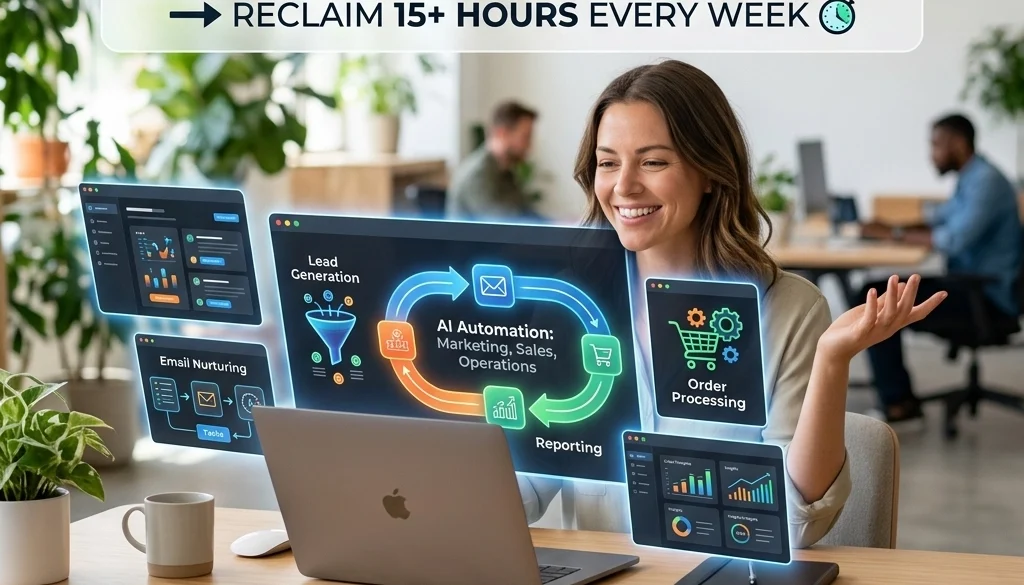
The target of 15 hours per week is achieved through the aggregation of three primary categories of automation.
1. Sales and Lead Management (6 Hours)
Manual lead triage involves reading incoming emails, checking CRM records, and assigning reps. An automated workflow performs these tasks in milliseconds.
- Lead Capture: Automated ingestion of form data.
- Scoring: AI evaluates the lead's potential value based on historical data.
- Routing: Immediate assignment to the relevant department.
This process is detailed in the ai website seo 2026 guide.
2. Administrative and Internal Communications (5 Hours)
Document processing and meeting management are primary sources of time loss.
- Meeting Summarization: AI agents transcribe calls and extract action items.
- Invoice Processing: Extraction of data from PDF invoices into accounting software.
- Report Generation: Automated aggregation of weekly performance metrics.
3. Customer Support and Engagement (4 Hours)
Standard inquiries regarding pricing or status are handled by AI agents.
- Auto-responders: Handling 70% of common support tickets.
- Review Requests: Post-purchase automated follow-ups.
- Status Updates: Proactive notifications regarding order or project status.

Technical Infrastructure: n8n and Open Source
n8n serves as a primary orchestration tool for SMBs. It is an open-source workflow automation platform that allows for self-hosting.
Advantages of n8n
- Data Privacy: Hosting the platform on private servers ensures sensitive business data remains internal.
- Cost Efficiency: No per-execution fees common in platforms like Zapier.
- Flexibility: Native nodes for AI models allow for direct integration with OpenAI, Anthropic, or self-hosted LLMs.
The implementation of offshore web mobile apps guide methodologies often utilizes n8n for backend synchronization.
Detailed Workflow Example: Automated Lead Qualification
A typical workflow for an SMB using AI agents:
- Input: User submits a request on the ai-website-creation page.
- Trigger: Webhook sends data to n8n.
- AI Node: An LLM analyzes the request for budget and timeline indicators.
- Condition: If "Qualified," create a deal in the CRM and send a Calendly link. If "Unqualified," send a polite resource guide.
- Output: Sales team receives a summary via Slack.

AI Automation ROI
The Return on Investment (ROI) is calculated by comparing the cost of automation development against the hourly rate of reclaimed labor.
- Formula: (Hours Saved × Employee Hourly Rate) – (Monthly Automation Maintenance Cost) = Monthly ROI.
SMBs can utilize the ai-automation-roi-calculator to determine specific financial outcomes.
Comparing Global Implementation Costs
Implementation costs for automation vary by region. Marketrun provides services for both US clients and India clients. The custom software india vs usa cost 2026 report indicates that hybrid development models offer the highest efficiency for SMBs.
Implementing Self-Hosted AI
For businesses with strict data governance requirements, self-hosting is the preferred method.
- Architecture: LLMs are deployed on private cloud infrastructure.
- Benefit: Zero data leakage to third-party model providers.
- Maintenance: Managed through ai-development services.
Detailed steps are available in the self-hosting-llms-2026-guide.

Steps for SMB Adoption
To reclaim 15 hours weekly, businesses must follow a systematic deployment plan.
Phase 1: Audit
Identify the top three time-consuming manual tasks. Document the exact steps taken by human staff.
Phase 2: Selection
Select a toolset. For most SMBs, n8n combined with a central LLM (like GPT-4o or Claude 3.5) is sufficient.
Phase 3: MVP Development
Build a single workflow, such as "Email Triage." Test for accuracy over 14 days.
Phase 4: Scaling
Expand into multi-agent systems where agents communicate with each other to complete complex projects.
Conclusion of System Status
The integration of ai automation workflows is a prerequisite for operational scalability in 2026. SMBs utilizing these systems report a reduction in human error and an increase in lead conversion rates due to decreased response times. Current data indicates that businesses failing to adopt AI agents will face a significant competitive disadvantage regarding labor costs and operational velocity.
For detailed service structures and pricing, refer to the pricing page or explore additional resources on the blog. Detailed site structure is available at the sitemap.