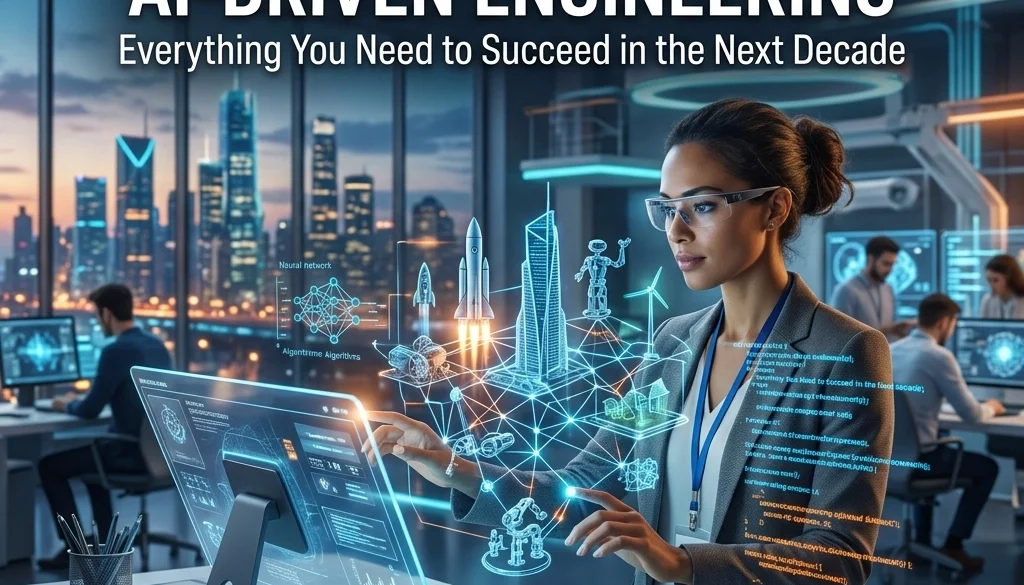
The Ultimate Guide to AI-Driven Engineering: Everything You Need to Succeed in the Next Decade
Structural Shift: The AI Engineering Transition
The software engineering discipline is undergoing a transition from deterministic programming to probabilistic system design. AI engineering represents the convergence of machine learning, software development, and systems operations. Success in the next decade requires an understanding of autonomous systems and the integration of large language models (LLMs) into production environments.
Software development protocols now incorporate AI as a primary layer. This shift prioritizes the management of intelligence over the writing of static code. Marketrun identifies this transition as the "AI-Native Era," where engineering focus moves from manual implementation to architectural oversight and agentic orchestration.
Core Pillars of AI Systems Engineering
AI systems engineering is the foundation for scalable intelligence. It involves the design of infrastructure capable of supporting model inference and data processing at scale.
Scalable Infrastructure and Cloud Integration
Infrastructure must support high-compute workloads. Engineering teams utilize cloud platforms such as AWS and Azure to establish production-grade environments. Key requirements include:
- Secure API integration for model access.
- Automated deployment pipelines (MLOps).
- Scalable GPU clusters for inference and fine-tuning.
MLOps and Continuous Management
Managed intelligence involves the continuous monitoring of models post-deployment. Performance degradation, known as model drift, is addressed through established MLOps cycles. These cycles ensure models are retrained or optimized as new data becomes available.

Data Management and Governance
Data is the primary determinant of model reliability. High-quality data preparation is a prerequisite for effective AI-driven engineering.
Data Structuring and Cleaning
Raw data requires cleaning and structuring to remove noise. Unbiased results are dependent on the quality of the underlying datasets. Engineering teams implement automated pipelines to transform unstructured data into formats suitable for training and retrieval.
Data Governance
Governance frameworks ensure compliance with data privacy regulations. This is critical for businesses operating in regulated sectors. Secure data handling is a central component of custom software development at Marketrun.
Technical Competencies for the AI Engineer
Modern AI system design requires proficiency in specific technical domains. These competencies move beyond traditional full-stack development into the realm of generative architectures.
LLM Architectures and Optimization
Engineers must understand the mechanics of transformers, diffusion models, and Variational Autoencoders (VAEs). Optimization techniques are required to manage latency and cost:
- KV Caching: Reduces computational overhead during token generation.
- Model Compression: Techniques like quantization and pruning for edge deployment.
- Self-Hosting: For organizations requiring data sovereignty, self-hosting LLMs is a viable path.
Retrieval-Augmented Generation (RAG)
RAG systems connect LLMs to external data sources. This provides models with access to real-time information and proprietary business data. Engineers evaluate retrieval tradeoffs between latency and accuracy to ensure system performance.
Fine-Tuning and Model Adaptation
Fine-tuning methods, including Low-Rank Adaptation (LoRA), allow for the specialization of general models. This process adapts a model to specific industry terminology or task-specific requirements.

AI Agents for Business: The New Workforce
The integration of ai agents for business is a primary trend for the 2026-2036 decade. Agents operate as autonomous entities capable of performing complex tasks within a software ecosystem.
Agentic Workflows in the SDLC
The Software Development Lifecycle (SDLC) is now augmented by agents. Agents participate in:
- Planning: Analyzing requirements and generating technical specifications.
- Development: First-pass code generation and implementation of boilerplate logic.
- Testing: Automated bug detection and unit test generation.
- Deployment: Monitoring system health and executing rollbacks.
Engineers transition into the role of reviewers and decision-makers. The mechanical aspects of building are offloaded to agentic systems, increasing overall throughput. Detailed strategies for these workflows are available in our ai agents and automations guide.
Multi-Agent Systems and MCP
Multi-agent systems utilize multiple specialized agents to complete a single goal. The Model Context Protocol (MCP) provides a standardized way for agents to communicate and share context, reducing fragmentation in complex systems.
Custom AI Solutions for SMBs: Strategic Implementation
Small and Medium-sized Businesses (SMBs) utilize custom ai solutions for smbs to achieve parity with larger enterprises. Strategic implementation focuses on high-impact automation and cost-efficiency.
ROI-Driven Automation
Automation is prioritized based on Return on Investment (ROI). Businesses utilize tools like the AI automation ROI calculator to determine the feasibility of new projects. Marketrun provides ai automations that target repetitive internal processes.
Accessibility and Cost-Efficiency
Custom software is no longer restricted to large budgets. Competitive pricing models and offshore development capabilities allow SMBs to deploy sophisticated AI systems. Comparison of costs between regions is available for India and US-based clients.

Developer Workflows and Productivity Gains
AI-assisted coding increases developer output. Statistics indicate measurable time savings when engineers utilize prompting techniques.
Advanced Prompt Engineering
Deterministic engineering replaces trial-and-error prompting. Techniques include:
- Meta-prompting: Directing an AI to generate its own prompts.
- Prompt-chaining: Breaking complex tasks into a sequence of smaller prompts.
- Few-shot learning: Providing examples within the prompt to guide output.
Code Generation and Maintenance
AI tools are deployed for code generation, debugging, and documentation. This reduces the time required for maintenance and allows engineers to focus on high-level architecture and system integration.
Marketrun’s Vision: The Next Decade of Software
Marketrun views the next decade as an era of autonomous, self-healing software. Our vision includes:
- Autonomous Deployment: Systems that identify performance bottlenecks and scale or refactor themselves without human intervention.
- Edge Intelligence: Widespread deployment of localized AI models for privacy and speed.
- Open Source Dominance: A shift toward open source deployment to avoid vendor lock-in.
- Integrated AI Web Creation: Websites that evolve based on user interaction data using AI-driven creation tools.
Marketrun remains committed to delivering custom AI development that aligns with these future trends.
Learning Path for AI Engineering Success
Professional development in this field requires a structured approach to learning and implementation.
- Foundations: Mastery of machine learning principles and statistical analysis.
- Frameworks: Utilization of tools such as LangChain, Hugging Face, and Scikit-learn.
- Experimentation: Building practical projects to observe model behavior in real-world scenarios.
- Specialization: Focusing on high-growth areas such as RAG, agentic systems, or specialized model fine-tuning.

Systemic Integration: Conclusion of Principles
AI-driven engineering is the standard for modern software development. Organizations that integrate these principles into their core operations will maintain a competitive advantage. The focus remains on building production-grade, secure, and scalable systems that leverage the full potential of artificial intelligence.
For further technical resources, visit the Marketrun blog or explore our solutions pages for specific implementation strategies.