AI Agents for Business 101: A Beginner’s Guide to Mastering AI Automation Workflows
AI Agent Classification and Functional Definition
AI agents are autonomous software systems designed to execute objectives by interacting with digital environments. These systems utilize Large Language Models (LLMs) as central reasoning engines. Unlike traditional software that follows rigid, linear scripts, AI agents possess the capacity to interpret instructions, decompose complex goals into discrete tasks, and select appropriate tools for execution.
In the context of small and medium-sized businesses (SMBs), ai agents for business function as digital personnel. These agents operate within ai automation workflows to perform continuous, multi-step operations without manual intervention. The primary distinction between standard automation and an AI agent is the ability to handle unstructured data and make decisions based on contextual logic rather than predefined "if-then" statements.
Operational Mechanics: The Cycle of Execution
The functionality of AI agents is categorized into three distinct phases: Observation, Planning, and Action.
Observation Phase
The agent monitors specific data streams or environmental triggers. Input sources include:
- Incoming electronic mail.
- Database updates in Customer Relationship Management (CRM) systems.
- Social media engagement metrics.
- Real-time sensor data or API pings.
Planning Phase
Upon receiving an input, the reasoning engine analyzes the objective. The agent performs task decomposition, identifying the sequence of sub-tasks required to achieve the final state. This phase involves:
- Context retrieval from long-term or short-term memory.
- Hypothesis generation for problem resolution.
- Validation of internal logic before proceeding to execution.
Action Phase
The agent executes the plan by interfacing with external software tools. This includes writing to databases, generating content, updating project management boards, or communicating with human stakeholders via messaging platforms.

Technical Architecture of AI Automation Workflows
The implementation of ai automation workflows requires an orchestration layer. Platforms such as n8n provide the necessary infrastructure to connect AI agents with business applications.
Integration with n8n
n8n is a node-based workflow automation tool that supports self-hosting and cloud deployment. It allows for the creation of complex chains where data flows between various services. In an AI-driven workflow, n8n serves as the "nervous system," while the AI agent acts as the "brain."
Component Breakdown:
- Triggers: Nodes that initiate the workflow based on events (e.g., a new lead in a Webflow form).
- AI Agent Nodes: Specific nodes within n8n that house the LLM and the instructions (prompts) for the agent.
- Memory Nodes: Components that allow the agent to retain information from previous interactions, ensuring continuity.
- Tool Nodes: Connections to external APIs (e.g., Google Sheets, Slack, OpenAI, or internal databases).
For businesses seeking specialized configurations, custom software development allows for the creation of proprietary nodes and deeper integration with legacy systems.

Business Value for SMBs: Time and Resource Allocation
The deployment of AI agents aims to reduce the volume of manual, repetitive tasks performed by human staff. Current data indicates that SMBs implementing these systems can reclaim 10 to 20 hours of labor per week per department.
Quantitative Benefits:
- Labor Efficiency: Automation of data entry and initial lead qualification.
- Error Reduction: Elimination of manual transcription errors in data migration.
- Response Latency: AI agents provide 24/7 responsiveness to customer inquiries or system alerts.
Use Case: Lead Management and CRM Update
In a manual lead management process, a staff member must read an email, identify the lead's intent, open the CRM, create a contact, and assign a follow-up task.
An ai automation workflow executes this sequence in seconds:
- Agent identifies the incoming lead.
- Agent extracts name, company, and budget from the email body.
- Agent checks the CRM for existing records.
- Agent creates a new record and drafts a personalized response based on historical data.
- Agent notifies the sales team via Slack.
The calculation of return on investment for these implementations can be evaluated using the AI Automation ROI Calculator.
Core Capabilities of Professional AI Agents
Professional-grade AI agents differ from basic chatbots through advanced reasoning modules.
Recursive Reasoning
Agents can evaluate their own output. If a task fails or an API returns an error, the agent analyzes the failure and attempts an alternative strategy. This self-correction loop is vital for maintaining workflow integrity without human supervision.
Data Synthesis
AI agents possess the ability to aggregate information from disparate sources. An agent can pull sales data from Stripe, marketing spend from Meta Ads, and inventory levels from an ERP system to generate a unified status report. This provides management with real-time insights for strategic decision-making.

Strategic Implementation for Small and Medium Businesses
Adopting ai agents for business requires a structured approach to ensure technical stability and data security.
1. Process Identification
Determine which processes are repetitive and data-heavy. Priority is given to workflows with high frequency and low complexity of judgment.
2. Tool Selection
Selecting the right environment for deployment is critical. n8n is often preferred for SMBs due to its flexibility and the ability to maintain self-hosted LLMs for enhanced data privacy.
3. Prompt Engineering and Guardrails
The behavior of the AI agent is dictated by system prompts. It is necessary to establish constraints to prevent the agent from taking unauthorized actions or generating hallucinations. Guardrails include:
- Output formatting requirements (e.g., "Return only JSON").
- Access limitations (e.g., "Read-only access to the financial database").
- Human-in-the-loop triggers for high-stakes decisions.
For comprehensive guidance on setting up these systems, refer to the AI Automations Solution Page.
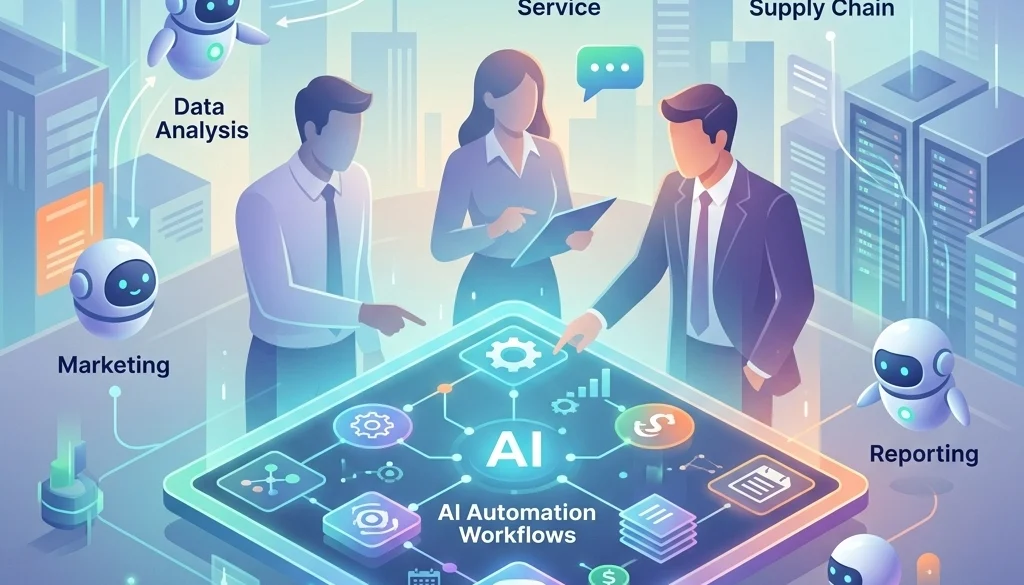
Specific Applications Across Business Functions
Marketing and Content Operations
AI agents monitor keyword performance and autonomously generate draft content for review. They can manage social media distribution schedules based on engagement data, optimizing for peak interaction times.
Human Resources
The screening of resumes and scheduling of interviews is a high-volume task. AI agents extract candidate qualifications, compare them against job descriptions, and use calendar integrations to book meetings with qualified applicants.
Financial Operations
Agents assist in invoice reconciliation. By comparing received invoices against purchase orders and bank statements, agents identify discrepancies and flag them for human review, automating the majority of the bookkeeping cycle.

Security and Ethics in AI Automation
Data privacy is a primary concern for businesses deploying AI agents. Utilizing public LLM endpoints involves sending internal data to third-party servers. To mitigate risk, businesses can utilize open-source deployment strategies to run models on local infrastructure.
Ethical Guardrails:
- Transparency: Identifying when a communication is initiated by an AI agent.
- Accountability: Maintaining logs of every action taken by the agent for audit purposes.
- Data Sovereignty: Ensuring customer data remains within secure, encrypted environments.
Maintenance and Scalability
AI automation is not a static implementation. As business requirements change, the workflows must be adjusted.
- Monitoring: Continuous tracking of agent performance and success rates.
- Updating: Refining prompts based on model updates or changes in business logic.
- Scaling: Expanding the agent's toolset to include more business applications as the organization grows.
For businesses operating in different markets, such as clients in India or clients in the US, the localization of AI agents involves adjusting language models and compliance parameters to meet regional regulations.
Conclusion: The Shift to Agentic Workflows
The transition from manual processes to ai automation workflows represents a fundamental change in business operations. By utilizing ai agents for business, SMBs can achieve levels of efficiency previously reserved for large enterprises with significant IT budgets. The integration of tools like n8n, combined with specialized AI development, enables a scalable infrastructure that grows alongside the company.