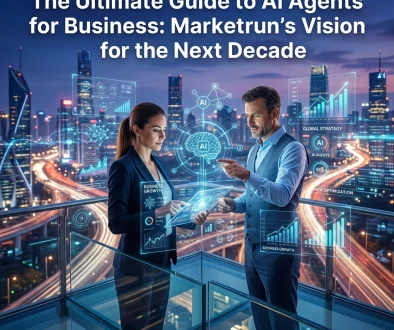
The Ultimate Guide to AI-Driven Engineering: Everything You Need to Succeed in the New Software Era
AI Engineering Definition and Classification
AI engineering is the discipline of designing and implementing systems that utilize artificial intelligence to execute complex tasks. The field integrates software engineering principles with machine learning operations. This discipline ensures that AI models are transitioned from experimental environments to production-grade status.
Current engineering standards require a departure from traditional development cycles. The integration of generative models necessitates new workflows. Marketrun categorizes these workflows under AI Development. The objective is the creation of scalable infrastructure capable of supporting autonomous operations.
Marketrun Vision: The 2026-2036 Decade
The subsequent ten years of software development are defined by the transition from human-centric coding to agent-centric orchestration. Manual code production is undergoing a reduction in total volume. Systemic generation is the primary method of delivery.
Marketrun focuses on the deployment of custom ai solutions for smbs. This focus addresses the requirement for small and medium-sized businesses to maintain technical parity with larger enterprises. The vision includes a decentralized software landscape where self-hosted models ensure data sovereignty. Detailed analysis of these trends is available in the AI agents and automations guide 2026.

Core Pillars of AI-Driven Engineering
Implementation of AI-driven systems requires the synchronization of three primary pillars: Systems Engineering, Data Management, and Managed Intelligence.
1. AI Systems Engineering
Systems engineering involves the architectural design of infrastructure. This pillar focuses on scalability and security. Production-grade systems require cloud platforms or on-premise hardware capable of managing high-concurrency requests.
Key components include:
- API development for model interaction.
- Automated deployment pipelines (MLOps).
- Integration with Custom Software frameworks.
- Latency optimization for real-time inference.

2. Data Preparation and Management
Model performance is contingent upon data quality. Data management protocols include cleaning, structuring, and governing datasets. Systems must be established to handle high volumes of unstructured data.
Process requirements:
- Deduplication of records.
- Normalization of variables.
- Implementation of Retrieval-Augmented Generation (RAG) datasets.
- Compliance with regional data protection laws.
3. Managed Intelligence
Intelligence management refers to the post-deployment monitoring of models. Models are subject to performance degradation over time. Continuous retraining and optimization are necessary to maintain accuracy levels.
Operational tasks:
- Monitoring for model drift.
- Performance auditing via AI Automation ROI Calculator.
- Security patching of model weights.
- Feedback loop integration for supervised learning updates.
AI Agents for Business: Operational Frameworks
Ai agents for business are autonomous units capable of task execution without direct human supervision. These units operate using Large Language Models (LLMs) to process logic and initiate actions via external toolsets.
Autonomous Workflows
Workflow automation via agents reduces manual labor requirements. Agents are deployed to manage customer service, lead generation, and internal data processing. Marketrun provides these through AI Automations.
Agent capabilities:
- Multi-step reasoning (Chain of Thought).
- Tool use via API calls.
- Recursive task refinement.
- Context window management for long-term memory.

Custom AI Solutions for SMBs: Strategic Implementation
Small and medium-sized businesses require specific implementations that maximize return on investment. Custom ai solutions for smbs focus on high-impact areas such as automated content generation, predictive maintenance, and sales optimization.
Cost-Benefit Analysis
The adoption of custom solutions involves initial capital expenditure followed by a reduction in operational costs. Scaling is achieved through software rather than human resource expansion. Pricing structures for these implementations are detailed at Marketrun Pricing.
Integration with Existing Infrastructure
New AI layers must interface with legacy systems. Marketrun utilizes Mobile and Web Apps to provide interfaces for underlying AI logic. This ensures user accessibility across diverse device types.
Technical Infrastructure: Self-Hosting and Open Source
The reliance on third-party API providers introduces risks regarding cost and data privacy. The current software era emphasizes the deployment of open-source models on private infrastructure.
Self-Hosting LLMs
Self-hosting allows for complete control over the model environment. It eliminates recurring per-token costs. Guidance on this process is located at Self-Hosting LLMs.
Benefits of self-hosting:
- Data privacy and isolation.
- Fixed infrastructure costs.
- Custom fine-tuning of model weights.
- Offline operational capability.

Open Source Deployment
Marketrun facilitates Open Source Deployment. This involves selecting optimized models (e.g., Llama, Mistral) and configuring them for specific business use cases. Open source models frequently match proprietary model performance in specialized tasks.
Global Development Logistics: USA and India
The geography of development affects the delivery of custom software. Marketrun operates across multiple regions to optimize resource allocation and cost efficiency.
Regional Optimization
- USA Operations: Focused on strategy and high-level architecture. Specific services for US Clients.
- India Operations: Focused on engineering execution and scaling. Specific services for India Clients.
A detailed comparison of development costs and methodologies can be found in the Custom Software India vs USA cost 2026 guide.
Offshore Development Management
Offshore models require rigorous management to ensure quality. Successful engineering in the new era utilizes global talent pools. Procedures for managing these workflows are outlined in the Offshore Web and Mobile Apps Guide.
Specialized AI Applications
AI-Driven Web Creation
Website development now includes AI-integrated SEO and content generation. Marketrun offers AI Website Creation which automates the layout and optimization process. For SEO-specific technicalities, refer to AI Website SEO 2026.
Mobile Integration
AI functionality is increasingly delivered via mobile interfaces. Custom software must include responsive design and local model execution (Edge AI) where possible. This reduces server dependency and improves user experience latency.
Conclusion of Technical Requirements
Success in the new software era is defined by the ability to transition from manual processes to AI-driven engineering. This transition requires a structured approach to systems, data, and continuous intelligence management. Organizations utilizing ai agents for business and custom ai solutions for smbs position themselves for operational efficiency. Marketrun provides the necessary framework for this transition via the Marketrun Solutions portal.

Summary of Reference Materials
- Strategic pricing: marketrun.io/pricing
- AI development services: marketrun.io/solutions/ai-development
- Technical blog: marketrun.io/blog
- Site structure: marketrun.io/sitemap.xml
The documentation provided serves as a baseline for engineering teams and decision-makers within the modern software landscape. Adherence to these principles is recommended for sustained technical competitiveness.