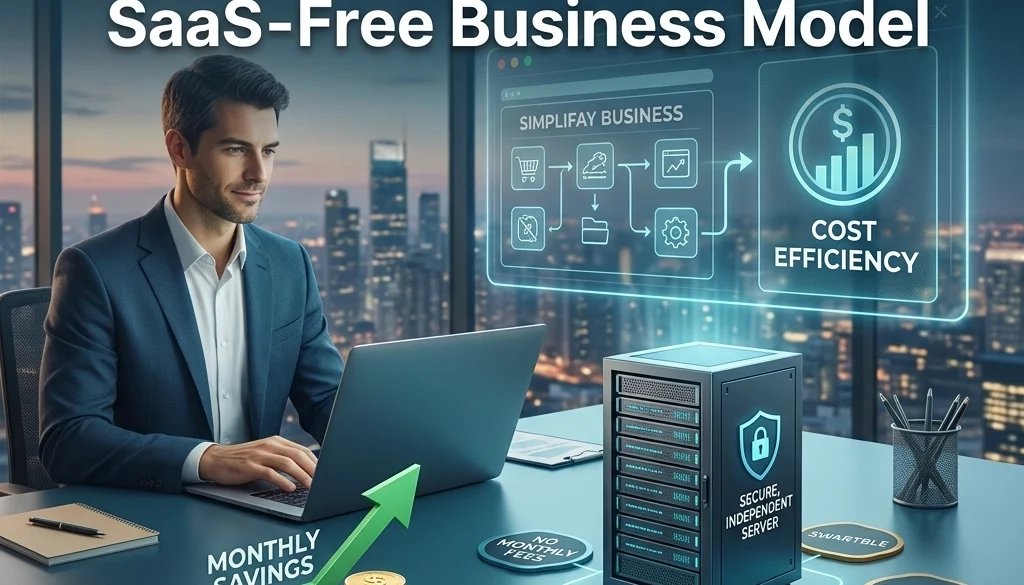
How to Save Thousands Monthly by Switching to a SaaS-Free Business Model
Financial State of SaaS Subscriptions
The subscription economy requires recurring monthly or annual payments. Costs increase as business operations expand. User seats, data storage, and feature access are common billing metrics.
Monthly expenditures for a standard technology stack often include:
- CRM: $50–$300 per user.
- Marketing Automation: $100–$1,000.
- Project Management: $10–$30 per user.
- Analytics: $20–$200.
- Communication: $7–$20 per user.
Total monthly costs for small teams range from $500 to $5,000. Large enterprises incur higher costs. Switching to a SaaS-free model involves replacing these services with self-hosted software.
Infrastructure: VPS Setup and Management
Self-hosting requires a Virtual Private Server (VPS). A VPS is a virtual machine sold as a service by an Internet hosting provider.
Server Selection
Hardware requirements depend on the software load. Common providers include Hetzner, DigitalOcean, and Linode.
- Entry-level: 2 vCPU, 4GB RAM.
- Mid-level: 4 vCPU, 16GB RAM.
- High-level: 8 vCPU+, 32GB RAM+.
Operating System and Environment
Ubuntu 24.04 LTS is a standard choice for stability. Docker and Docker Compose are used for containerization. Containerization isolates software environments and simplifies deployment.
VPS Setup Steps:
- Instance creation.
- SSH key configuration.
- Firewall activation (UFW).
- Docker installation.
- Reverse proxy setup (Nginx or Caddy) for SSL termination.
Detailed infrastructure guidance is available at Marketrun Open Source Deployment.

Open Source SaaS Alternatives: Automation
Zapier and Make facilitate data transfer between applications. These tools charge based on task volume.
n8n (Self-Hosted)
n8n is a node-based workflow automation tool. It allows for complex logic and data manipulation.
- Cost: $0 (Self-hosted version).
- Deployment: Docker.
- Capabilities: 400+ integrations, JavaScript function nodes, binary data handling.
Replacing a high-volume Zapier plan with n8n reduces monthly costs by $100–$800. For implementation details, see Marketrun AI Automations.

Open Source SaaS Alternatives: CRM and ERP
Customer Relationship Management (CRM) and Enterprise Resource Planning (ERP) software centralize customer data and business processes.
ERPNext
ERPNext is an open-source alternative to SAP and NetSuite. It includes modules for:
- Sales and Purchase.
- Accounting and Finance.
- Human Resources.
- Inventory Management.
- Manufacturing.
Mautic
Mautic serves as an alternative to HubSpot or Marketo for marketing automation. It handles:
- Lead tracking.
- Email campaigns.
- Form creation.
- Dynamic content.
A combination of ERPNext and Mautic eliminates the need for multiple high-cost subscriptions. Development support is provided via Marketrun Custom Software.
Open Source SaaS Alternatives: Communication and Collaboration
Proprietary communication tools like Slack or Microsoft Teams have recurring per-user fees and data retention limits on free plans.
Mattermost or Rocket.Chat
These platforms provide team messaging, file sharing, and search functionality.
- Hosting: On-premise or VPS.
- Security: Data remains within the company network.
- Integration: Compatible with n8n and Gitlab.
Nextcloud
Nextcloud replaces Google Workspace or Microsoft 365 for file storage and document editing. It includes:
- File synchronization.
- Calendar and Contacts.
- OnlyOffice or Collabora integration for real-time document collaboration.
Open Source SaaS Alternatives: Analytics
Google Analytics and Mixpanel track user behavior. Data privacy regulations require transparency regarding third-party data sharing.
Plausible or Matomo
These tools provide web analytics without tracking personal data.
- Plausible: Lightweight, privacy-focused, 100% data ownership.
- Matomo: Detailed reports, heatmaps, and session recordings.
Self-hosting analytics ensures compliance with privacy laws and removes reliance on external tracking scripts.

Operational Implementation Strategy
Transitioning to a SaaS-free model requires a phased approach.
Phase 1: Audit
Identify every active subscription. Record monthly costs, user counts, and critical features. Use the AI Automation ROI Calculator to determine potential savings.
Phase 2: Pilot Deployment
Select a low-risk tool for replacement. Deploy the open-source alternative on a VPS. Test data migration and user permissions.
Phase 3: Migration
Transfer data from the SaaS tool to the self-hosted instance. Perform a cutover during low-usage hours. Terminate the SaaS subscription.
Phase 4: Scaling
Increase VPS resources as more tools are added. Implement centralized authentication (SSO) using tools like Authelia or Keycloak.
Maintenance and Security Protocols
Self-hosting shifts responsibility for maintenance to the internal team or a service partner like Marketrun.
Backup Procedures
Automated backups are mandatory.
- Frequency: Daily or hourly.
- Storage: Off-site (Amazon S3, Backblaze B2).
- Recovery: Periodic testing of backup restoration.
Security Updates
Operating systems and software containers require regular updates.
- OS: Unattended upgrades for security patches.
- Docker: Image updates using Watchtower or manual cycles.
- Firewall: Restrict access to necessary ports (80, 443, 22).
Monitoring
Uptime and resource utilization must be monitored. Tools like Uptime Kuma or Grafana provide alerts for service outages or high CPU usage.

Economic Impact and ROI
The shift from OpEx (Operational Expenditure) to CapEx (Capital Expenditure) or reduced OpEx occurs when switching to self-hosting.
SaaS Model (3 Years):
- Monthly Subscriptions: $2,000.
- Total: $72,000.
Self-Hosted Model (3 Years):
- VPS Hosting ($100/mo): $3,600.
- Maintenance/Setup: $10,000.
- Total: $13,600.
Net Savings: $58,400.
Detailed cost comparisons between regions are found in the Custom Software India vs USA Guide.
Technical Constraints and Considerations
Self-hosting is not without limitations.
- Technical Expertise: Requires knowledge of Linux and Docker.
- Responsibility: The business handles downtime and data integrity.
- Upfront Time: Initial setup takes longer than signing up for a SaaS service.
Organizations without internal technical staff utilize Marketrun's managed deployment services to mitigate these constraints.
Data Sovereignty and Compliance
Data resides on company-controlled servers. This facilitates compliance with:
- GDPR (General Data Protection Regulation).
- HIPAA (Health Insurance Portability and Accountability Act).
- Local data residency laws.
SaaS providers often store data in jurisdictions outside the business's control. Self-hosting removes this risk.
Summary of State Transition
- From: Fragmented subscriptions, recurring high costs, third-party data control.
- To: Consolidated infrastructure, fixed low costs, total data ownership.
Implementation of open-source alternatives on a managed VPS reduces overhead and increases profit margins. For assessment of specific business needs, visit Marketrun Solutions.

Final Checklist for SaaS-Free Transition
- List all SaaS tools.
- Calculate total monthly spend.
- Identify open-source alternatives.
- Provision VPS.
- Deploy Docker environment.
- Configure backups and security.
- Migrate data.
- Cancel subscriptions.
The process is a systematic reduction of recurring liabilities. Monitoring of the Marketrun Blog provides ongoing updates on new self-hosted software releases and security practices.