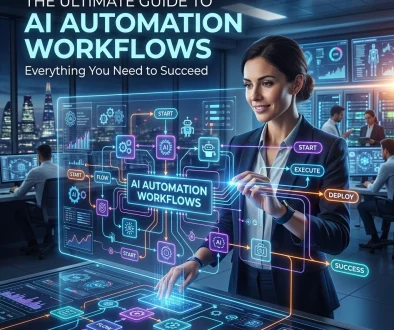
The Ultimate Guide to Automate Business Operations with AI: Everything You Need to Succeed
AI Automation: Definition and Operational Scope
AI automation is the integration of artificial intelligence technologies with functional workflows to perform business tasks. Unlike traditional automation, which relies on static, rule-based logic, AI-powered systems utilize machine learning, natural language processing (NLP), and computer vision to handle unstructured data and adaptive decision-making.
The primary objective to automate business operations with ai is the reduction of human intervention in repetitive, high-volume processes. This results in increased throughput, reduced error rates, and the ability to scale operations without proportional increases in headcount.
Comparative Analysis: Traditional vs. AI-Powered Automation
| Functional Aspect | Traditional Automation (RPA) | AI-Powered Automation |
|---|---|---|
| Decision Logic | Binary, fixed rules | Probabilistic, adaptive |
| Data Compatibility | Structured data (CSV, SQL) | Unstructured (Text, Images, Audio) |
| Error Management | Process termination on exception | Self-correction and anomaly detection |
| Learning Capacity | Static | Continuous improvement via data loops |
| Scalability | Linear | Exponential |

Strategic Framework for AI Automation Workflows
Successful implementation requires a structured sequence of actions. AI automation workflows must be mapped to identify logical trigger points and data exit nodes.
1. Process Mapping and Identification
Operational audits are conducted to identify tasks with high frequency and low complexity variability. Processes such as invoice reconciliation, lead scoring, and customer inquiry routing are primary candidates for automation.
2. Data Infrastructure Readiness
AI models require access to clean, centralized data. Disparate data silos must be consolidated into accessible formats. This often involves the deployment of custom software to act as a data bridge between legacy systems and modern AI agents.
3. Integration of Disparate Systems
A significant challenge in business operations is the fragmentation of software tools (CRM, ERP, Project Management). Connecting these systems is achieved through:
- API Orchestration: Utilizing Application Programming Interfaces to facilitate real-time data exchange.
- Middleware Deployment: Tools such as n8n, Zapier, or custom-built connectors serve as the logic layer between separate platforms.
- Webhooks: Event-driven triggers that push information from one system to another instantly upon specific actions.
For organizations requiring high security or data sovereignty, self-hosting LLMs ensures that automated workflows remain within the private cloud infrastructure.
Advanced Techniques for Connecting Disparate Systems
To automate business operations with ai effectively, internal systems must communicate without manual data entry. Advanced connectivity involves the following technical layers:
Vector Databases and RAG
Retrieval-Augmented Generation (RAG) allows AI agents to access proprietary company documentation stored in vector databases. This enables the AI to provide context-aware responses and actions across different departments.
Multi-Agent Orchestration
Rather than a single AI model, complex operations utilize multiple specialized AI agents. One agent may handle data extraction from emails, while another performs sentiment analysis, and a third updates the internal ERP. This modular approach increases system reliability.

High-Impact Operational Use Cases
Supply Chain and Inventory Management
AI models predict demand fluctuations by analyzing historical sales data and external market indicators.
- Automated Procurement: Purchase orders are generated automatically when stock levels reach a calculated threshold.
- Logistics Optimization: AI identifies efficient routing patterns, reducing fuel consumption and delivery times.
Customer Support and Engagement
AI agents handle Tier 1 support inquiries via automated chat interfaces.
- Resolution Rate: Approximately 70% of standard queries are resolved without human escalation.
- Availability: 24/7 operational capability across multiple time zones.
Human Resources and Recruitment
The recruitment funnel is optimized through:
- Automated Screening: AI parses resumes for specific skill sets and experience levels.
- Candidate Ranking: Scoring algorithms prioritize candidates based on historical success data.
- Onboarding Workflows: Automated triggers send documentation and access credentials to new hires.

Platform Selection Matrix
The choice of platform depends on the technical maturity and scale of the organization.
| Platform Category | Example Tools | Optimal Use Case |
|---|---|---|
| No-Code/Low-Code | Zapier, Make, n8n | Rapid deployment for SMEs |
| Enterprise RPA | UiPath, Blue Prism | Large-scale legacy system integration |
| Cloud AI Suites | Google Vertex AI, AWS Bedrock | Custom model development and training |
| Specialized AI Agents | Marketrun Solutions | End-to-end custom business automation |
Hyperautomation: The Future of Business Operations
Hyperautomation involves the simultaneous use of multiple technologies (AI, RPA, Process Mining) to automate every possible business process. This creates a self-optimizing ecosystem where the system identifies its own bottlenecks and suggests improvements.
Key Components of Hyperautomation:
- Process Mining: Analyzing event logs to identify how work is actually performed.
- Digital Twin of the Organization (DTO): A virtual model that simulates operational changes before deployment.
- Autonomous Decision Engines: AI systems that make financial or operational decisions within predefined guardrails.
For a detailed look at the ROI associated with these technologies, refer to the AI Automation ROI Calculator.
Quantifiable Business Outcomes
The transition to ai automation workflows results in measurable performance indicators:
- Cost Reduction: Operational expenses typically decrease by 15-30% within the first 12 months.
- Efficiency Gains: Processing speeds for tasks like document verification improve by up to 60%.
- Return on Investment (ROI): Successful implementations report an ROI of up to 240% depending on the scale of deployment.

Technical Implementation Steps
- Audit existing workflows: Document all manual touchpoints.
- Define success metrics: Establish KPIs such as "Time to Completion" or "Error Frequency."
- Develop a Pilot Program: Implement automation in a single department, such as AI-driven lead generation.
- Security Review: Ensure compliance with data protection regulations (GDPR, SOC2).
- Scale and Iterate: Expand the automation logic to adjacent departments based on pilot results.
For businesses operating across borders, understanding the cost dynamics between different development hubs is essential. Documentation on Custom Software India vs. USA Cost provides comparative data for budget planning.
Conclusion of Operational Guidelines
The integration of AI into business operations is a technical requirement for maintaining competitive parity. By connecting disparate systems and deploying sophisticated ai automation workflows, organizations transition from reactive to proactive operational states.
For further technical specifications or to begin a transition, view the available pricing models or explore the comprehensive guide to AI agents.
Marketrun provides the infrastructure for mobile and web application automation and open-source deployment strategies to facilitate these transitions. Specific regional requirements can be addressed via our US Client Portal or India Client Portal.