Are Traditional Dev Teams Dead? How AI-Driven Engineering is Redefining Software ROI
Current State of Software Engineering
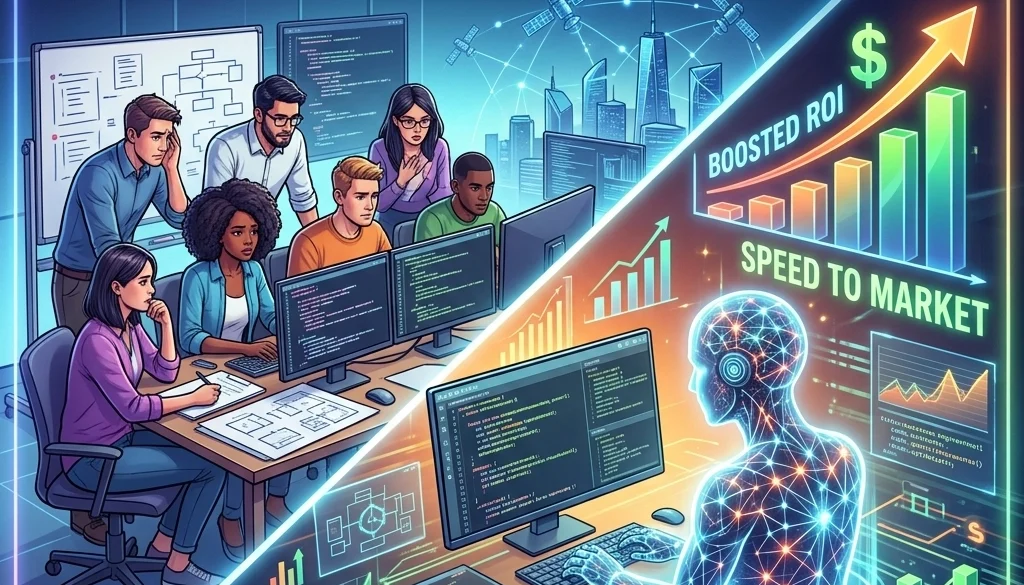
The traditional model of software development involves manual syntax generation, hierarchical management structures, and siloed departments. This model faces obsolescence. Data indicates a transition from manual coding to architectural orchestration. In 2026, the primary function of a software engineer is the management of AI systems rather than the manual entry of code.

Shift in Developer Roles
The role of the developer has moved from "maker" to "orchestrator." AI tools handle routine syntax, boilerplate code, and basic debugging. Human oversight focuses on high-level architecture and system design.
- Syntax Generation: Automated by Large Language Models (LLMs).
- Debugging: Conducted via automated diagnostic agents.
- Architecture: Maintained by human engineers.
- Validation: Human verification of AI-generated outputs is required.
The requirement for developers to memorize language-specific syntax is reduced. The requirement for developers to understand system logic and business requirements is increased.
Organizational Restructuring: The Rise of Fusion Teams
Traditional hierarchical structures are replaced by fusion teams. A fusion team consists of 5 to 9 members including architects, business stakeholders, and AI integration specialists.
Characteristics of Fusion Teams
- Cross-functionality: Direct integration of business intent with technical execution.
- Outcome Focus: Priorities are defined by business results rather than task completion.
- Minimized Handoffs: Direct communication between stakeholders reduces intent loss.
- Speed: Faster delivery cycles are observed compared to siloed teams.
Organizations utilizing fusion teams report higher efficiency in the deployment of custom software.

Custom AI Solutions for SMBs
Small and Medium Businesses (SMBs) now access capabilities previously reserved for large enterprises. Custom AI solutions for SMBs allow for the automation of specific business processes without the requirement for massive capital expenditure.
Implementation Areas for SMBs
| Category | Application | Impact |
|---|---|---|
| Customer Support | Automated resolution agents | Reduced response latency |
| Data Analysis | Pattern recognition in sales data | Improved inventory management |
| Operations | Workflow automation | Reduced manual labor hours |
| Marketing | Content generation and SEO | Increased digital presence |
Marketrun provides AI development services tailored to these requirements. The focus is on practical implementation and measurable ROI.
AI Agents for Business: The New Workforce
AI agents for business function as autonomous or semi-autonomous entities within a corporate environment. These agents perform tasks, interact with software interfaces, and make decisions based on predefined parameters.
Agentic Workflow Capabilities
- Multi-step Task Execution: Agents can navigate multiple software platforms to complete a single business process.
- Decision Logic: Agents apply business rules to handle routine approvals or data routing.
- Integration: Agents interface with existing mobile and web apps.
The deployment of AI agents and automations reduces the operational overhead of traditional dev teams. The focus shifts from maintaining code to maintaining agent behavior and data accuracy.

Redefining Software ROI
Return on Investment (ROI) in software is no longer measured solely by the time taken to ship a feature. Modern ROI metrics prioritize system performance, reliability, and the reduction of technical debt.
ROI Factors in AI-Driven Engineering
- Development Speed: AI-assisted coding reduces the time from concept to deployment.
- Operational Efficiency: Automated systems require fewer human interventions for maintenance.
- Scalability: AI-driven architectures handle increased loads with lower incremental costs.
- Maintenance: Self-healing code and automated testing reduce long-term costs.
For detailed analysis, refer to the AI automation ROI calculator.

Security and Non-Functional Requirements
As AI handles the "how" of coding, human engineers focus on the "what" and "why." Security, scalability, and performance are the primary differentiators in 2026.
Security Protocols
- Automated Threat Detection: AI systems monitor code for vulnerabilities in real-time.
- Compliance: Automated audits ensure adherence to data protection regulations.
- Validation: Human architects verify that security protocols are correctly implemented by AI agents.
The deployment of self-hosting LLMs is a strategy used by organizations to maintain data sovereignty while utilizing advanced AI capabilities. Guidance on this can be found in the self-hosting LLMs 2026 guide.
Global Engineering Models
The distinction between local and offshore development is changing. AI-driven engineering allows for standardized outputs regardless of geographical location.
Comparative Cost and Quality
Companies evaluate options based on the total cost of ownership. The custom software India vs USA cost guide provides a breakdown of these variables. Marketrun offers specific solutions for both US clients and India clients, focusing on high-quality engineering standards.

Technical Infrastructure and Deployment
Modern software requires robust infrastructure. AI-driven engineering relies on seamless deployment pipelines.
Deployment Solutions
- Open Source Deployment: Utilization of open source models and tools to reduce vendor lock-in. Open source deployment is a core service.
- Windows Software: Custom development for specific operating environments remains necessary for many SMBs. Windows software solutions are integrated with modern AI backends.
- AI Website Creation: Rapid generation of web interfaces using AI models. AI website creation focuses on both aesthetics and SEO performance.
The Next Decade of Software
The evolution of engineering indicates a future where software is fluid. Systems will adapt to user needs in real-time.
Predicted Developments
- Autonomous Maintenance: Systems that identify and fix their own bugs without human intervention.
- Natural Language Interfaces: Software development conducted through high-level natural language instructions.
- Hyper-Personalization: AI-driven applications that reorganize their UI/UX based on individual user behavior.
Traditional dev teams are not dead, but the "traditional" methodology is. The transition to AI-driven engineering is a requirement for competitive survival. Organizations must adapt to the orchestrator model to achieve maximum ROI.
Summary of Strategic Actions
To align with current engineering standards, organizations should:
- Transition from siloed departments to fusion teams.
- Implement AI automations to handle routine operational tasks.
- Focus internal resources on architecture, security, and strategy.
- Review pricing models to reflect AI-driven efficiency.
Marketrun continues to develop solutions that reflect this vision of engineering. The integration of AI into every phase of the software lifecycle is the current standard. For more information on these trends, the Marketrun blog provides regular updates on the state of technology.