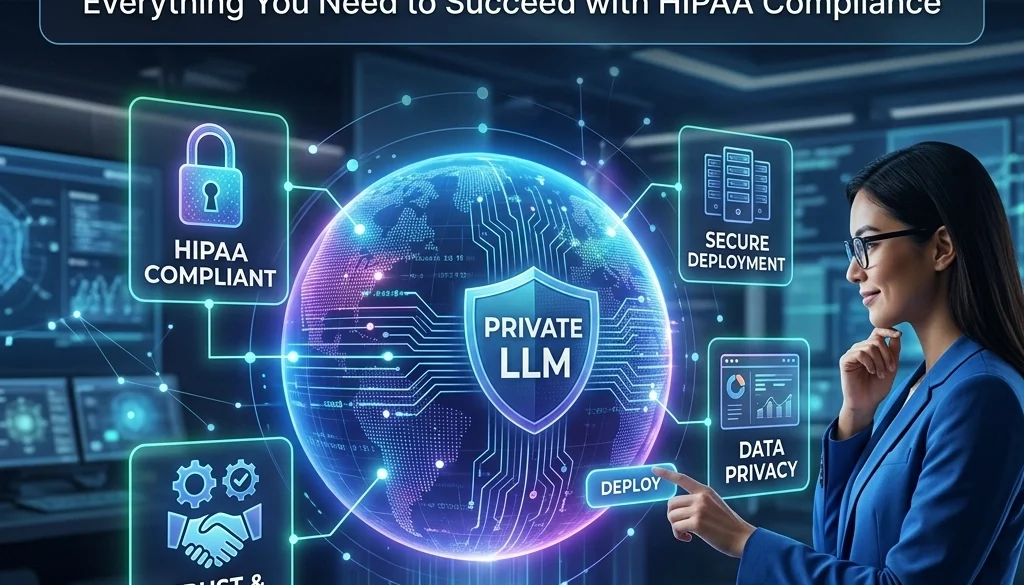
The Ultimate Guide to Private LLM Deployment: Everything You Need to Succeed with HIPAA Compliance
Infrastructure Status: Private LLM Deployment vs. Public API
Current industry status indicates a shift from public API consumption to private infrastructure. Public APIs (OpenAI, Anthropic, Google) transmit data to third-party servers. Data processing occurs outside the organizational firewall. For entities requiring HIPAA or GDPR compliance, this architecture presents risks regarding data residency and unauthorized access.
Private LLM deployment involves running models on controlled hardware. This hardware exists either on-premises or within a dedicated Virtual Private Cloud (VPC). Data remains within the security perimeter. No external entities access the input tokens or generated outputs. This approach satisfies the fundamental requirements for Protected Health Information (PHI) security.
Comparison Table: Data Governance
| Feature | Public API (OpenAI/Anthropic) | Private LLM Deployment |
|---|---|---|
| Data Residency | Third-party servers | Local/Controlled servers |
| Data Training | Possible use for model improvement | None |
| Network Perimeter | External | Internal |
| Compliance Path | BAA required, configuration limited | Full control over safeguards |
| Latency | Dependent on internet/provider | Hardware-dependent |
For organizations seeking tailored configurations, custom ai solutions for smbs provide a framework for these transitions.
HIPAA Compliance Framework: Technical Safeguards
HIPAA requires specific technical safeguards for electronic PHI (ePHI). Private LLM deployment enables the implementation of these safeguards at the infrastructure level.
Encryption Protocols
Encryption is required for data at rest and data in transit.
- At Rest: Storage volumes containing model weights and database records must utilize AES-256 encryption.
- In Transit: All API calls between the application layer and the LLM inference engine must use TLS 1.2 or higher.
- Key Management: Organizations maintain control of encryption keys. Vendor access to keys is eliminated.
Access Control Systems
The LLM infrastructure requires strict identity management.
- Authentication: Implementation of multi-factor authentication (MFA) for server access.
- Authorization: Role-Based Access Control (RBAC) determines which users or services can query specific models.
- Automatic Logoffs: Session termination after periods of inactivity prevents unauthorized access to terminal sessions.

Audit Controls and Logging
HIPAA mandates the recording and examination of activity in systems containing ePHI.
- Event Logs: Systems must log user IDs, timestamps, query metadata, and system responses.
- Retention: Logs must be stored for a minimum of six years.
- Immutability: Log files should be transmitted to a centralized, write-once-read-many (WORM) storage system.
Detailed information on infrastructure setup is available at marketrun.io/self-hosting-llms.
HIPAA Compliance Framework: Administrative Safeguards
The deployment of private LLMs necessitates administrative oversight to ensure adherence to healthcare regulations.
Risk Analysis and Management
- Initial Assessment: Identification of potential vulnerabilities in the hardware, software, and network configuration.
- Mitigation Strategy: Implementation of security measures to reduce risks to a reasonable and appropriate level.
- Ongoing Review: Periodic updates to the risk assessment as model updates or hardware changes occur.
Business Associate Agreements (BAA)
If the private LLM is hosted on third-party cloud infrastructure (AWS, Azure, GCP), a BAA is required. The BAA defines the responsibilities of the cloud provider regarding the protection of ePHI. In a fully on-premises deployment, the need for external BAAs is reduced, though internal service-level agreements remain relevant.
Workforce Training
Staff interacting with the LLM must receive training on the handling of PHI within the context of generative AI. This includes the prevention of "prompt injection" attacks that could lead to unauthorized data egress.
HIPAA Compliance Framework: Physical Safeguards
Physical safeguards protect the physical hardware housing the LLM.
Facility Access Controls
- Secure Locations: Servers must be placed in locked racks within data centers with restricted badge access.
- Visitor Logs: Documentation of all individuals entering the physical space where the LLM hardware resides.
Device and Media Controls
- Disposal: Hard drives and storage media used for LLM caching or logging must be shredded or magnetically degaussed when decommissioned.
- Redundancy: Implementation of backup systems to ensure data availability during hardware failure.
Organizations can explore open-source deployment to understand the physical hardware requirements for various model sizes.
Data Protection Strategies: De-identification
De-identification is the process of removing identifiers from a dataset so that the remaining information cannot be used to identify an individual.
Safe Harbor Method
The removal of 18 specific identifiers, including:
- Names
- Geographic subdivisions smaller than a state
- All dates (except year) directly related to an individual
- Telephone numbers
- Social Security numbers
- Medical record numbers
Expert Determination Method
A statistical expert applies mathematical principles to ensure the risk of re-identification is very small. In the context of private LLMs, de-identification layers are placed before the inference engine to ensure the model never "sees" raw PHI.
Architecture Options for Private LLM Deployment
1. On-Premises Hardware
Physical servers are owned and operated by the organization.
- Hardware: NVIDIA H100/A100 GPUs or specialized AI accelerators.
- Network: Fully air-gapped or restricted to internal LAN.
- Control: Maximum control over every layer of the stack.
2. Virtual Private Cloud (VPC)
The LLM runs on cloud-provider hardware but within an isolated network segment.
- Provider: AWS (Bedrock/SageMaker), Azure (OpenAI Service – Private Instance), or GCP (Vertex AI).
- Isolation: Use of VPC endpoints and PrivateLink to ensure traffic does not traverse the public internet.
- Compliance: Requires a signed BAA from the cloud provider.
3. Edge Deployment
Small, quantized models run on local workstations or medical devices.
- Tools: Llama.cpp, Ollama, or MLC LLM.
- Use Case: Real-time clinical notes or device diagnostics without network dependency.
Refer to custom software solutions for integration strategies across these architectures.

Economic Analysis: Private Deployment vs. API Subscription
Cost Components of Private LLM
- Capital Expenditure (CapEx): Purchase of GPU-accelerated servers. A production-ready node typically ranges from $10,000 to $40,000.
- Operational Expenditure (OpEx): Electricity, cooling, and maintenance personnel.
- Software: Implementation of inference engines (vLLM, TGI) and API wrappers.
Cost Components of Public API
- Token Pricing: Charges per 1,000 tokens (input and output).
- Scalability: Costs increase linearly with usage volume.
- Data Overhead: Costs associated with fine-tuning and data storage on vendor platforms.
ROI Projection
For high-volume SMBs, the initial investment in private llm deployment typically achieves parity with API costs within 12 to 18 months. Beyond this period, the marginal cost of inference is significantly lower. Detailed pricing structures for development support are available at marketrun.io/pricing.
Implementation Roadmap
The transition to a private, HIPAA-compliant LLM involves the following sequential phases:
Phase 1: Model Selection
Identify a base model that meets performance requirements. Common choices include:
- Llama 3 (Meta)
- Mistral / Mixtral (Mistral AI)
- Phi-3 (Microsoft)
Models are selected based on parameter count, context window size, and licensing terms.
Phase 2: Hardware Provisioning
Secure hardware capable of running the selected model. Memory (VRAM) is the primary constraint.
- 7B models: 8GB – 16GB VRAM.
- 70B models: 48GB – 80GB VRAM.
Phase 3: Software Stack Deployment
Installation of the inference server and API gateway.
- OS: Linux (Ubuntu/RHEL).
- Drivers: NVIDIA CUDA Toolkit.
- Containerization: Docker/Kubernetes for scaling and isolation.
- Orchestration: Management tools to handle request queuing and load balancing.
Phase 4: Compliance Validation
Conduct a technical audit. Verify encryption, logging, and access controls. Ensure no data egress to unauthorized external endpoints.
Phase 5: Application Integration
Connect internal applications to the private LLM endpoint. Replace existing OpenAI/Anthropic API keys with internal base URLs.
For assistance with specific use cases like ai-automations, technical support is available.
Status Summary: The Current State of Private AI
Private LLM deployment is a feasible alternative to public cloud services. It provides a technical foundation for HIPAA compliance. It eliminates risks associated with third-party data processing. It offers long-term cost advantages for high-volume users.
Key Indicators:
- Data Security: Controlled within the perimeter.
- Compliance Status: Capable of meeting HIPAA/GDPR standards.
- Scalability: Hardware-dependent.
- Cost: High initial CapEx, low ongoing OpEx.
Organizations interested in regional development capabilities can explore options for US clients or India clients to optimize deployment logistics.
For further information on automation strategies, visit the Marketrun blog.