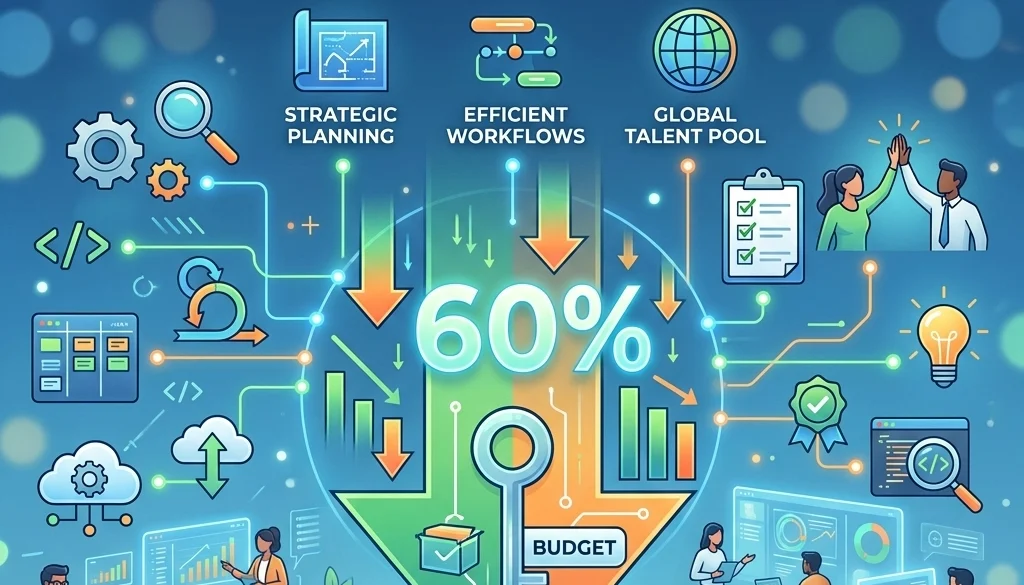
Custom Application Development Secrets Revealed: How Our Clients Cut Costs by 60% Without Sacrificing Quality
Executive Summary
Market data from April 2026 indicates that custom application development costs frequently exceed initial budgets by 40% to 200%. Analysis of successful projects at Marketrun identifies a specific methodology that reduces these expenditures by 60%. This reduction is achieved through systematic MVP prioritization, geographic resource optimization, and the utilization of cross-platform frameworks. The following documentation details the transition from conceptualization to production for startups and established enterprises.
Phase 1: Minimum Viable Product (MVP) Prioritization
The initial stage of custom software development involves the identification of core functional requirements. Data confirms that 45% of features in traditional software deployments are never used.
Feature Filtering
Reducing the initial scope to essential functions decreases development time and capital expenditure. An MVP focuses on the primary problem the application intends to solve.
- Requirement Analysis: Documentation of must-have versus nice-to-have features.
- User Path Mapping: Streamlining the interface to support the primary user objective.
- Cost Impact: Limiting the scope at the onset prevents "feature creep," which is responsible for 30% of budget overruns.

Market Validation
Launching an MVP allows for the collection of user data before secondary capital is committed. This approach ensures that subsequent website development and application development are informed by actual user behavior rather than theoretical assumptions.
Learn more about custom software solutions.
Phase 2: Technical Architecture and Framework Selection
The selection of the technology stack dictates the long-term maintenance costs and the speed of the initial build.
Cross-Platform Development
For mobile and web applications, the use of cross-platform frameworks is a primary driver of the 60% cost reduction.
- Frameworks: React Native and Flutter allow for a single codebase to serve both iOS and Android platforms.
- Efficiency: This approach eliminates the need for separate development teams for different operating systems.
- Maintenance: Updates are applied to a single codebase, reducing long-term operational costs by 50%.
Web and Mobile Integration
Modern mobile and web apps utilize unified backend systems. By utilizing Node.js or Python-based backends, developers ensure high performance and scalability.
- API-First Design: Ensures the application can integrate with future AI agents and automations.
- Scalability: Cloud-native architectures using AWS or Firebase allow the infrastructure to grow with the user base without upfront hardware investment.

Phase 3: Geographic Resource Strategy (The 60% Metric)
Labor costs represent the largest variable in application development. Regional economic differences provide an opportunity for significant arbitrage.
Cost Comparison 2026
Data comparison between development regions:
- North America/Western Europe: $120 – $200 per hour.
- India/Eastern Europe: $30 – $60 per hour.
| Region | Average Hourly Rate (USD) | 1,000 Hour Project Cost |
|---|---|---|
| USA | $150 | $150,000 |
| India | $40 | $40,000 |
| Savings | -73% | $110,000 |
By utilizing skilled developers in India, Marketrun clients achieve quality levels equivalent to domestic production at a fraction of the cost. For detailed analysis, see the India vs USA cost guide 2026.

Quality Control in Offshore Development
The 60% cost reduction is only viable if quality is maintained. Marketrun implements the following protocols:
- Overlap Working Hours: Ensuring daily communication and synchronization.
- Standardized Documentation: Technical specifications are written in English to ensure clarity.
- Continuous Integration/Continuous Deployment (CI/CD): Code is automatically tested and deployed to staging environments for client review.
Read the offshore web and mobile apps guide for further implementation details.
Phase 4: Development Methodology and Agile Execution
The process of building custom software is iterative. The Agile methodology is employed to maintain transparency and control over the budget.
Sprints and Iterations
Development is divided into two-week "sprints."
- Transparency: At the end of each sprint, a functional version of the software is presented.
- Flexibility: Adjustments to the direction of the project can be made every 14 days based on feedback.
- Risk Mitigation: Early detection of technical challenges prevents expensive mid-project corrections.

Automated Testing
Manual testing is labor-intensive and prone to error. Marketrun utilizes automated testing suites to verify code integrity.
- Unit Testing: Validates individual components.
- Integration Testing: Ensures different parts of the system work together.
- Regression Testing: Guarantees that new updates do not break existing functionality.
Phase 5: Deployment and Production
Transitioning from a development environment to a live production environment requires strategic planning to avoid downtime and security vulnerabilities.
Cloud Infrastructure and Open Source
Infrastructure costs are minimized by using open-source components and optimized cloud configurations.
- Open Source Deployment: Utilizing proven libraries reduces the need for "from-scratch" coding. Details are available at open source deployment.
- Self-Hosting LLMs: For applications requiring AI, self-hosting Large Language Models can reduce API costs significantly. Refer to the self-hosting LLMs 2026 guide.
Post-Launch Monitoring
Once the application or website is live, monitoring tools track performance, user engagement, and error rates.
- Performance Optimization: Ensuring load times remain under 2 seconds.
- Security Updates: Regular patching of software dependencies to protect user data.

Quantitative Impact and ROI
The financial benefits of this development model extend beyond the initial build cost.
Operational Efficiency
Custom applications designed for specific business workflows typically result in:
- 45% increase in operational efficiency.
- 85% reduction in manual data entry errors.
- 4x Return on Investment (ROI) over a three-year period.
Clients can calculate potential savings using the AI automation ROI calculator.
Long-term Maintenance
Applications built with modern, standardized frameworks (React, Flutter, Node.js) have a longer lifecycle and lower maintenance requirements compared to legacy systems or low-code "no-code" platforms that suffer from vendor lock-in and limited scalability.
Summary of Results
The 60% cost reduction identified in Marketrun client projects is the result of a scientific approach to software engineering. By combining:
- Strategic scope limitation (MVP).
- Modern tech stacks (Cross-platform).
- Global labor optimization (India-based development).
- Automated workflows (Agile/CI/CD).
Organizations can deploy high-quality custom software that remains within budget and scales with market demand.
For project estimation and pricing, visit the Marketrun pricing page. Information regarding services for specific regions can be found for US clients and India clients.