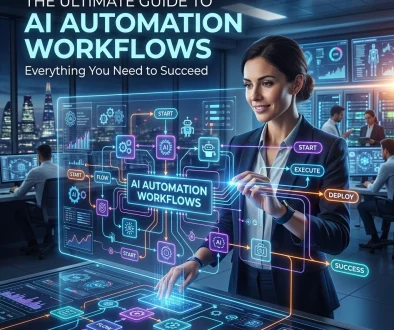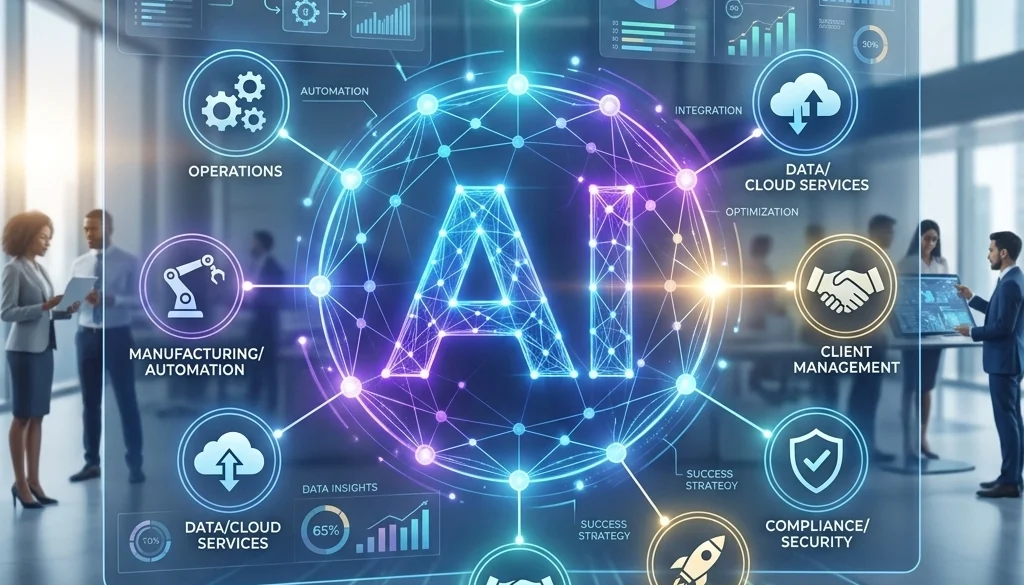
The Ultimate Guide to Automate Business Operations with AI: Everything You Need to Succeed
AI Automation Overview
Business operations transition from manual task execution to autonomous system management through Artificial Intelligence. AI automation integrates machine learning algorithms with operational workflows to manage data, make decisions, and execute tasks. Unlike traditional robotic process automation (RPA), which operates on static rules, AI-powered systems process unstructured data and adapt to variable inputs.
The implementation of these systems aims to increase throughput and reduce operational expenditure. Statistics indicate a cost reduction of 15% to 30% across various sectors. Operational efficiency increases by approximately 60% when AI-driven workflows replace manual intervention.
Core Objectives of AI Business Automation
The primary functions of AI in a business environment include:
- Cost Minimization: Reduction of labor costs and resource waste.
- Accuracy Enhancement: Elimination of human error in data entry and processing.
- Throughput Increase: Systems operate continuously without downtime.
- Scalability: Expansion of operational capacity without proportional increases in headcount.
- Predictive Capability: Use of historical data to forecast future operational requirements.

Advanced Integration: Connecting Disparate Systems
To automate business operations with ai, disparate software systems must be connected to ensure data liquidity. Information silos prevent the effective application of AI models.
Integration Architecture
- API Layer Deployment: Application Programming Interfaces (APIs) serve as the primary communication bridge between CRM, ERP, and project management tools.
- Middleware Orchestration: Tools such as Zapier, n8n, or custom-built middleware facilitate data transfer between incompatible software environments.
- Data Normalization: Systems convert varying data formats into a standardized structure for AI processing.
- Webhook Implementation: Real-time event triggers notify AI agents to initiate specific actions based on system changes.
Connecting these systems allows for complex ai automation workflows where data from a sales CRM triggers inventory updates in an ERP and generates logistics requests in a supply chain module simultaneously. For technical implementation of these structures, refer to Marketrun AI Automations.

Structural Components of AI Automation Workflows
Effective workflows follow a sequential logic: Ingestion, Analysis, Decision, and Execution.
Data Ingestion
Systems collect data from multiple sources, including emails, PDFs, database entries, and sensor logs. Natural Language Processing (NLP) identifies relevant entities within unstructured text.
Analysis and Inference
Machine learning models analyze the ingested data. LLMs (Large Language Models) categorize intent, summarize content, or extract specific variables. For sensitive data, self-hosting LLMs ensures data residency compliance.
Decision Logic
The AI evaluates the data against predefined business parameters. If the data meets specific confidence thresholds, the system proceeds to execution. If thresholds are not met, the system routes the task to human-in-the-loop (HITL) stations.
Automated Execution
The system interacts with external software via API calls or browser automation to complete the task. Examples include generating an invoice, updating a customer record, or sending a notification.
Categories of Implementation
Customer Support Operations
AI agents manage ticket categorization, sentiment analysis, and automated responses. High-frequency queries are resolved without human intervention. Complex issues are routed to specialized departments based on intent detection.
Financial and Accounting Automation
Invoice processing involves OCR (Optical Character Recognition) to extract data from documents. Systems validate figures against purchase orders and initiate payment protocols. This reduces the cycle time for accounts payable.
Human Resources and Recruitment
AI systems screen candidate profiles against job descriptions. Scoring algorithms rank candidates based on technical keywords and experience levels. Interview scheduling is handled via automated calendar synchronization.
Supply Chain and Logistics
Predictive models analyze market trends and historical sales to adjust inventory levels. Automation triggers reorder points with suppliers when stock reaches calculated thresholds. Route optimization algorithms reduce delivery times and fuel consumption.

Platform Selection Framework
The choice of platform depends on organizational scale and technical requirements.
| Scale | Recommended Tooling | Integration Depth |
|---|---|---|
| Small Business | Zapier, n8n, Microsoft Copilot | High (No-code) |
| Mid-Market | Appian, Power Automate | Medium (Low-code) |
| Enterprise | UiPath, Custom AI Agents, LLMs | Deep (Custom Code) |
For enterprises requiring specific functionality, custom software development provides high-performance alternatives to off-the-shelf platforms.
Implementation Phases
The deployment of AI automation follows a structured lifecycle.
Phase 1: Process Auditing
Identification of tasks with high volume and low complexity. Evaluation of technical feasibility for automation.
Phase 2: Technical Mapping
Documentation of data flows between existing systems. Definition of security protocols and access permissions.
Phase 3: Pilot Deployment
Installation of an automation prototype within a controlled environment. Monitoring of performance metrics and error rates.
Phase 4: Full-Scale Integration
Expansion of the automation to the entire department. Training of personnel on system monitoring and exception handling.
Phase 5: Continuous Optimization
Regular updates to machine learning models based on new data. Refinement of workflow logic to handle edge cases.

Advanced AI Technologies for Automation
Machine Learning (ML)
ML algorithms enable systems to identify patterns in historical data. This technology is applied in fraud detection, demand forecasting, and predictive maintenance.
Natural Language Processing (NLP)
NLP facilitates the understanding of human language. It is essential for automating document-heavy processes and customer interactions. Detailed guides on these agents are available at AI Agents and Automations Guide.
Computer Vision
Systems analyze visual data from cameras or static images. Applications include quality control in manufacturing and automated document scanning.
Multimodal AI
Models process multiple data types (text, image, audio) simultaneously. This allows for more complex automations, such as analyzing a video call to generate a summarized project plan and updating a task board.
Measuring ROI and Performance
The efficacy of AI automation is quantified through specific Key Performance Indicators (KPIs).
- Labor Hours Saved: Total time redirected from manual tasks to high-value activities.
- Error Rate Reduction: Comparison of human error frequency versus AI error frequency.
- Process Cycle Time: Time elapsed from task initiation to completion.
- Operational Cost Per Transaction: Total cost associated with a single unit of work.
Tools for calculating these metrics are found at the AI Automation ROI Calculator.
Risk Mitigation and Governance
Automating business operations with AI requires oversight to prevent algorithmic bias and data breaches.
- Data Privacy: Implementation of encryption and anonymization for sensitive data.
- Audit Logs: Maintenance of detailed records for every automated action to ensure accountability.
- Model Monitoring: Regular checks for "model drift," where AI performance degrades over time as data environments change.
- Human Oversight: Inclusion of manual verification steps for high-stakes decisions.
Comparison: AI vs. Traditional Automation
| Feature | Traditional RPA | AI-Powered Automation |
|---|---|---|
| Data Type | Structured (Spreadsheets) | Unstructured (Email, Voice, Image) |
| Logic | Fixed Rules (If/Then) | Probabilistic (Pattern Recognition) |
| Exception Handling | Stops/Requires Human | Attempts Resolution/Learns |
| Setup Complexity | Low | High |
| Long-term Value | Static | Increasing (Self-improving) |

Conclusion on Strategic Deployment
The transition to AI-integrated operations is a technical requirement for maintaining market competitiveness. By connecting disparate systems and deploying structured ai automation workflows, organizations achieve higher precision and lower operational costs.
For organizations operating in different geographical markets, cost-benefit analyses vary. Information regarding the differences in deployment costs can be reviewed in the Custom Software India vs USA Guide.
Technical support and development services are available through Marketrun's Solutions. Organizations seeking to implement these technologies should begin with a comprehensive audit of existing digital infrastructure.