The Ultimate Guide to Automate Business Operations with AI: Everything You Need to Succeed
Operational Status of AI Automation in 2026
The implementation of artificial intelligence within corporate infrastructures serves as a mechanism for process optimization. AI automation combines machine learning algorithms with automated execution to perform cognitive tasks. Current data indicates that entities utilizing these systems observe operational cost reductions ranging from 15% to 30%. This transformation is characterized by the transition from rule-based logic to adaptive learning models.
Core Distinctions Between Traditional and AI Automation
Traditional automation functions through predefined logic. AI-powered automation functions through data pattern recognition and contextual analysis.
| Feature | Traditional Automation | AI-Powered Automation |
|---|---|---|
| Logic Source | Hard-coded rules | Machine learning models |
| Data Input | Structured data | Structured and unstructured data |
| Scalability | Linear | Exponential |
| Error Handling | Manual intervention required | Self-correcting mechanisms |
| Adaptability | Static | Continuous improvement |
To automate business operations with ai requires a shift from static scripts to dynamic ai automation workflows.
Advanced Strategies for Connecting Disparate Systems
The primary obstacle in business automation is the fragmentation of data across isolated platforms. Connecting these systems is necessary for comprehensive operational efficiency.
API-First Integration
Application Programming Interfaces (APIs) facilitate the exchange of data between disparate software environments. A centralized integration layer allows for the synchronization of ERP, CRM, and legacy databases.
- Identification: Cataloging all software endpoints within the organization.
- Authentication: Implementation of OAuth2 or API keys for secure data transit.
- Mapping: Translation of data schemas between source and destination systems.
Middleware and Orchestration Layers
Middleware acts as a buffer and translator between incompatible systems. Orchestration platforms manage the sequence of events across multiple applications. These layers ensure that an update in a customer database triggers corresponding actions in billing and fulfillment modules without manual oversight.
AI-Driven Data Mapping
Disparate systems often utilize different naming conventions for identical data points. AI models are deployed to identify semantic similarities between fields (e.g., "Client_ID" vs. "CustomerNumber"), enabling automated synchronization of data silos.

Technical Architecture of AI Automation Workflows
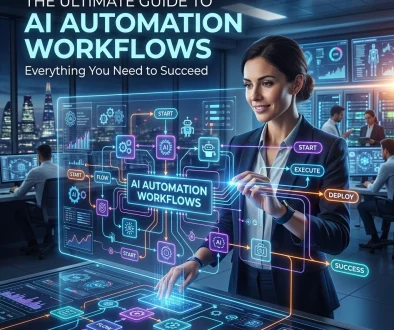
An effective workflow consists of four primary components: Triggers, Processing, Logic, and Execution.
1. Trigger Initialization
Workflows are initiated by specific events. These include the arrival of an email, a database update, or a scheduled temporal threshold. In advanced settings, AI monitors streams of data to identify "soft" triggers: patterns that suggest an intervention is required before a hard threshold is met.
2. Cognitive Processing
Input data is processed through Natural Language Processing (NLP) or Computer Vision. This stage extracts entities, sentiment, and intent from unstructured inputs such as PDFs, voice recordings, or images.
3. Decision Logic
Machine learning models evaluate the processed data against historical parameters to determine the optimal response. Unlike simple "If-Then" statements, these models assess probability and risk levels.
4. Automated Execution
The final action is performed across the connected systems. This includes updating records, generating documents, or initiating communication protocols. Organizations seeking specific builds for these architectures often utilize custom software development.

Functional Applications Across Business Units
Customer Support Operations
AI agents handle high-volume inquiries by accessing knowledge bases and transaction histories.
- Resolution Rate: 70-80% for tier-1 queries.
- Availability: 24/7/365.
- Escalation: Automated routing to human agents when sentiment analysis detects frustration or high complexity.
Details on deploying these agents are available in the AI agents and automations guide.
Human Resources and Recruitment
The automation of the recruitment lifecycle involves:
- Resume Screening: Matching candidate profiles to job descriptions using semantic search.
- Onboarding: Automated generation of legal documentation and hardware provisioning.
- Employee Support: Internal bots addressing policy inquiries and leave requests.
Finance and Accounting
The integration of AI into financial workflows minimizes manual entry errors.
- Invoice Processing: OCR technology extracts data from invoices and matches it with purchase orders.
- Fraud Detection: Real-time analysis of transaction patterns to identify anomalies.
- Predictive Analysis: Forecasting cash flow based on historical cycles and market data.
Supply Chain and Logistics
AI monitors inventory levels and external variables (e.g., weather, shipping delays) to adjust procurement schedules.
- Inventory Optimization: Reduction of overstock and stockout events.
- Route Planning: Real-time adjustment of delivery paths for fuel and time efficiency.
Implementation Roadmap for AI Automation
Successful deployment follows a structured sequence to ensure stability and return on investment.
Phase 1: Process Auditing
Identification of tasks that are repetitive, high-volume, and data-dependent. Processes are ranked based on the potential for ROI. The AI automation ROI calculator is a standard tool for this assessment.
Phase 2: Pilot Development
Selection of a single, isolated workflow for automation. This serves as a proof of concept. Small-scale testing allows for the refinement of models without disrupting core operations.
Phase 3: Infrastructure Selection
Decision between cloud-based services and self-hosted solutions. For entities with high data privacy requirements, self-hosting LLMs provides maximum control over data residency.
Phase 4: Integration and Scaling
Expansion of the pilot project to adjacent departments. Systems are connected via the methods described in the "Connecting Disparate Systems" section.

Security and Governance in Automated Environments
Automation introduces new vectors for operational risk. Governance frameworks must be established.
- Access Control: Least-privilege access models for automated agents.
- Audit Logging: Immutable records of every action taken by an AI system.
- Human-in-the-Loop (HITL): Mandatory human approval for high-value or high-risk decisions.
- Data Encryption: End-to-end encryption for data in transit between integrated systems.
For organizations operating internationally, understanding the differences in deployment costs and compliance is critical. A comparison of custom software in India vs USA provides context for resource allocation.
Measurement of Success
The performance of AI automation is quantified through specific metrics:
- Cycle Time: The duration required to complete a process from start to finish.
- Error Rate: The frequency of inaccuracies in automated outputs compared to manual outputs.
- Resource Reallocation: The amount of human labor hours redirected from repetitive tasks to strategic initiatives.
- Throughput: The volume of data or transactions processed within a specific timeframe.

Strategic Conclusion on System Maturity
Automating business operations with ai is a continuous process of refinement. As systems collect more operational data, the accuracy of the underlying models increases. Integration of disparate systems through robust ai development ensures that the organization functions as a unified, data-driven entity.
For further technical specifications or to begin a deployment, refer to the Marketrun solutions page. Detailed guides on specific technologies, such as mobile and web apps or open source deployment, offer deeper insights into the technical requirements for modern business infrastructure.
The current state of technology enables the total synchronization of business functions. Strategic implementation allows for the removal of operational bottlenecks and the establishment of a scalable foundation for future growth.