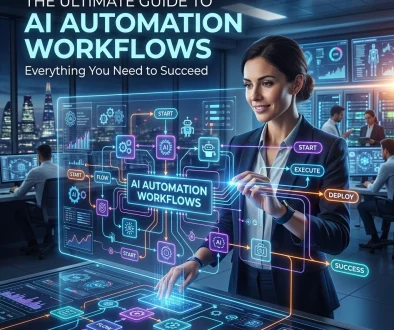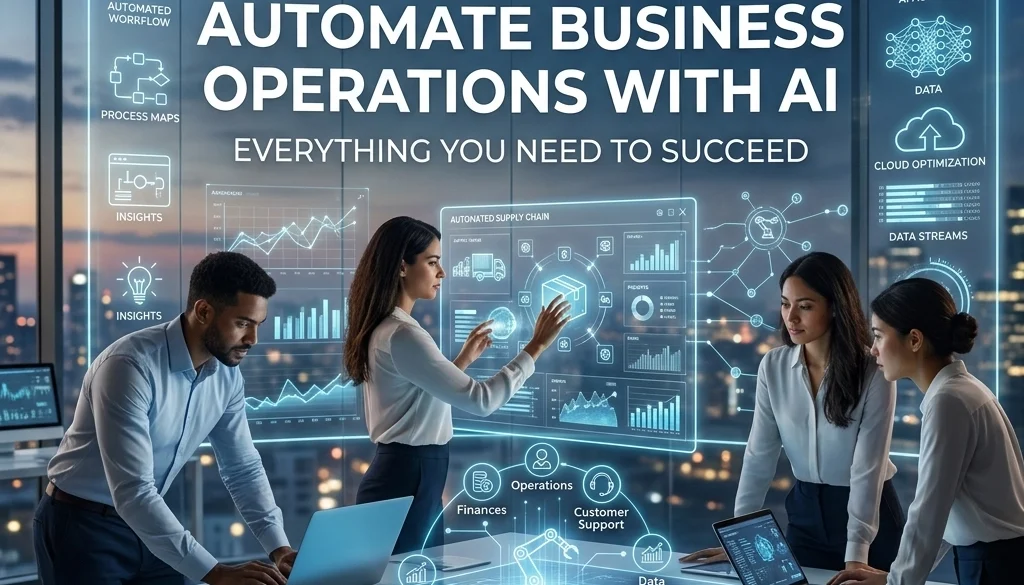
The Ultimate Guide to Automate Business Operations with AI: Everything You Need to Succeed
Operational Definition of AI Automation
AI automation is the deployment of machine learning algorithms and autonomous agents to execute rule-based and cognitive tasks. Unlike legacy automation, which follows static scripts, AI-driven systems process unstructured data, adapt to environmental changes, and improve through iterative learning. To automate business operations with ai effectively, internal workflows must transition from manual intervention to supervised machine execution.
Primary benefits identified in 2026 include:
- Reduction in operational expenditure: 15-30%.
- Increase in processing speed: 50-80%.
- Error rate minimization in high-volume data entry.
- Scalability without proportional headcount increases.
Phase 1: Operational Audit and Process Mapping
Systematic automation requires an initial audit of existing workflows. Processes characterized by high volume, repetitive logic, and digital data inputs are primary candidates.
Identification Criteria
- High Frequency: Tasks performed daily or hourly.
- Rule-Based Logic: Procedures defined by clear "if-then" conditions.
- Data Intensity: Workflows involving significant data extraction, transformation, or entry.
- Bottleneck Impact: Steps where human latency delays subsequent operations.
Visualization Requirements
Standard Operating Procedures (SOPs) must be mapped using process mining or flowchart software. Documented flows reveal the "as-is" state versus the intended "to-be" automated state. Inaccurate mapping leads to the automation of inefficiencies rather than their removal.

Phase 2: Advanced System Connectivity and Integration
A primary challenge in business automation is the fragmentation of data across disparate software ecosystems. To successfully automate business operations with ai, internal and external systems must be bridged.
Connecting Disparate Systems
- API-First Architecture: Utilization of RESTful or GraphQL APIs to facilitate data exchange between ERPs, CRMs, and AI models.
- Webhooks: Implementation of real-time event triggers. When an action occurs in System A, a notification is sent to the AI agent to initiate a response in System B.
- Middleware Solutions: Deployment of integration layers that act as a central nervous system for data flow.
- Custom Adapters: Where native APIs are unavailable, custom software development is required to build bridges to legacy local systems. Marketrun's custom software solutions specialize in these technical bridges.
Data Harmonization
Data from different sources often lacks a unified format. AI automation workflows require a centralized data schema. Pre-processing layers must normalize data before it reaches the AI logic tier to ensure output accuracy.
Phase 3: Architecting AI Automation Workflows
Effective ai automation workflows are structured as a series of connected modules. Each module performs a specific function: data ingestion, cognitive processing, and action execution.
Common Workflow Architectures
- The Triage Workflow: Incoming requests (emails, tickets) are analyzed by an LLM, categorized, and routed to the appropriate department or automated responder.
- The Extraction Workflow: Unstructured documents (invoices, contracts) are processed via Optical Character Recognition (OCR) and LLMs to populate structured databases.
- The Synchronization Workflow: AI agents monitor changes in one platform and update relevant records across all other connected platforms to maintain a "Single Source of Truth."

Phase 4: Core Business Applications
Customer Service and Engagement
Deployment of AI agents for tier-one support queries. These agents utilize Retrieval-Augmented Generation (RAG) to provide accurate answers based on internal documentation. For advanced setups, visit Marketrun AI Automations.
Finance and Procurement
Automation of the order-to-cash cycle. AI systems verify invoice accuracy against purchase orders, flag anomalies for human review, and execute payments upon approval.
Human Resources and Recruitment
Automated screening of candidate profiles based on pre-defined technical benchmarks. AI agents handle interview scheduling and initial onboarding documentation collection.
Supply Chain Management
Predictive analytics combined with automated procurement. Systems monitor inventory levels and market trends, automatically generating restock orders when thresholds are met.

Phase 5: Technical Implementation and Tool Selection
The selection of a technology stack determines the long-term viability of the automation strategy.
Selection Criteria
- Scalability: Ability to handle increased request volume without latency.
- Security: Adherence to data protection regulations (GDPR, SOC2).
- Maintainability: Ease of updating logic as business rules change.
- Deployment Model: Choice between cloud-hosted services and self-hosting LLMs for sensitive data.
Development Approaches
- Off-the-shelf Platforms: Rapid deployment for standard workflows but limited customization.
- Custom AI Development: Tailored agents designed for specific proprietary processes. This is recommended for businesses with unique operational requirements. Detailed insights are available via Marketrun AI Development.
Phase 6: Governance, Security, and Compliance
Automation introduces specific risks related to data privacy and algorithmic bias.
Governance Framework
- Audit Logs: Every automated action must be recorded for accountability.
- Human-in-the-Loop (HITL): High-stakes decisions (financial transfers, legal approvals) require a human verification step.
- Data Residency: Compliance with local laws regarding where data is processed and stored. For clients in specific regions, tailored compliance information can be found for US clients and India-based operations.
Model Monitoring
AI models are subject to "drift" where performance degrades over time. Continuous monitoring of accuracy metrics and regular retraining schedules are mandatory for operational stability.

Phase 7: Scaling and Optimization
Initial automation projects should focus on a "Pilot and Pivot" strategy.
- Pilot: Select one high-impact, low-complexity workflow.
- Measure: Quantify results against established KPIs (hours saved, error reduction).
- Refine: Adjust the AI logic based on pilot feedback.
- Scale: Expand the framework to adjacent departments.
Hyperautomation
The ultimate stage of maturity is hyperautomation: the integration of multiple AI agents and automated systems into a unified, self-optimizing ecosystem. This removes the need for manual hand-offs between different automated departments. For a deeper understanding of the 2026 landscape, refer to the AI Agents and Automations Guide.
Advanced Technical Tips for Connecting Systems
To achieve high-level connectivity between disparate systems:
- Standardize on JSON: Use JSON as the universal data interchange format to simplify AI parsing.
- Implement Error Handling: Build "retry" logic and "dead-letter queues" for when an external API fails to respond.
- Use Vector Databases: Store internal knowledge in vector formats (e.g., Pinecone, Weaviate) to allow AI agents to "search" through company data in real-time.
- State Management: For multi-step workflows, implement a state management layer to track the progress of an automation task across different systems.

Financial Evaluation of AI Automation
Investment in AI automation is assessed through Return on Investment (ROI).
| Metric | Description |
|---|---|
| Direct Cost Savings | Reduced labor costs for repetitive tasks. |
| Indirect Cost Savings | Elimination of costs associated with human error and compliance fines. |
| Opportunity Gain | Revenue generated by reallocating human staff to high-value strategic roles. |
| Throughput Increase | Ability to handle 10x the workload without increasing overhead. |
For detailed calculations, utilize the AI Automation ROI Calculator.
Conclusion of Systemic Deployment
Automating business operations with AI is an iterative technical requirement rather than a one-time project. Success is dependent on clean data, robust system connectivity, and a structured implementation roadmap. Businesses utilizing these frameworks gain a significant competitive advantage through operational efficiency and data-driven decision-making.
To explore specific deployment options, visit the Marketrun Solutions page.