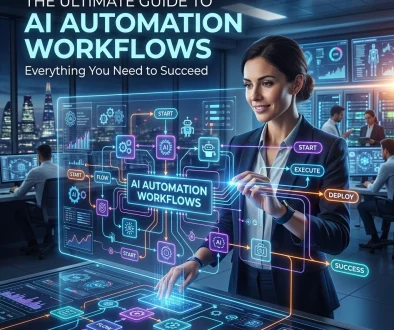
The Ultimate Guide to Automate Business Operations with AI: Everything You Need to Succeed
Operational Status: Artificial Intelligence in Business Functions
Business operations consist of repeatable processes, data management, and decision-making cycles. To automate business operations with ai requires the deployment of machine learning models and robotic process automation into existing organizational frameworks. Traditional automation utilizes static rules. AI automation utilizes dynamic data processing.
Definition of AI Automation
AI automation is the synthesis of cognitive technologies and workflow execution. Systems perceive inputs, analyze content, and execute tasks. These systems operate without human intervention for defined parameters.
Current Industry Standards
As of April 2026, standard operations incorporate:
- Natural Language Processing (NLP) for document analysis.
- Computer Vision for physical asset management and security.
- Predictive Analytics for resource allocation.
- Generative AI for content and code production.
System Integration: Connecting Disparate Architectures
Advanced automation requires the unification of separated software environments. Disparate systems create data silos. Silos prevent autonomous decision-making.
Integration Methodologies
- API Orchestration: Systems communicate via Application Programming Interfaces. REST and GraphQL protocols facilitate data exchange between cloud-based platforms.
- Middleware Deployment: Intermediate software layers translate data formats between legacy systems and modern AI agents.
- Webhooks: Real-time event notifications trigger specific ai automation workflows across external platforms.
- ETL Pipelines: Extract, Transform, and Load processes move data into centralized warehouses for model training and inference.
For technical execution of these integrations, refer to Marketrun AI Automations.

Visual representation of API orchestration between CRM, ERP, and AI processing layers.
Overcoming Legacy Constraints
Legacy systems lack native AI compatibility. Integration involves:
- Wrapping legacy functions in API containers.
- Utilizing screen scraping for systems without accessible databases.
- Implementing edge computing for local data processing.
AI Automation Workflows: Technical Frameworks
Workflows are sequences of tasks. AI-driven workflows adapt based on data variables.
Finance and Accounting Workflows
- Invoice Processing: AI identifies data points on PDF documents. Data enters ERP systems. Discrepancies trigger alerts.
- Fraud Detection: Models monitor transaction patterns. Deviations result in immediate account locks.
- Expense Management: Optical Character Recognition (OCR) converts receipt images into ledger entries.
Human Resources Workflows
- Candidate Screening: Models parse resumes against job descriptions. Ranking occurs based on keyword density and experience metrics.
- Onboarding: Automated systems generate documentation and provide access credentials based on employee role definitions.
Sales and Marketing Workflows
- Lead Scoring: Algorithms assign values to prospects based on interaction history.
- Content Distribution: Systems schedule and publish materials across multiple channels based on audience activity data.
- Inquiry Response: AI agents handle initial customer contact. High-complexity issues transition to human operators.
Detailed ROI analysis for these workflows is available at the AI Automation ROI Calculator.
Technical Requirements for Implementation
Success in AI automation depends on infrastructure readiness.
Data Requirements
- Volume: Sufficient historical data is necessary for model accuracy.
- Quality: Data must be structured and cleaned. Errors in training data result in flawed automation.
- Security: Protocols must comply with regional regulations (GDPR, CCPA).
Compute and Hosting
Options for model hosting include:
- Public Cloud: High scalability. Recurring costs.
- Self-Hosting: High initial investment. Data privacy control. Reference: Self-Hosting LLMs 2026 Guide.

Development Strategies and Cost Analysis
Organizations must choose between internal development and external procurement.
Custom Software Development
Custom solutions address specific operational bottlenecks. Marketrun provides Custom Software Development for specific business logic.
Regional Cost Variations
Costs fluctuate based on the location of the development team.
- North American Development: High hourly rates. Minimal time zone offset for US-based entities.
- Offshore Development (India): Lower hourly rates. Requires structured communication protocols.
Comparison data is located at Custom Software India vs USA Cost 2026.

Comparative chart of development costs and resource allocation across different geographic regions.
Advanced Automation Tips for Scalability
- Modular Architecture: Build automation in independent blocks. Failure in one block does not stop the entire system.
- Continuous Monitoring: Implement feedback loops. Human-in-the-loop (HITL) processes ensure model drift is identified and corrected.
- Prompt Engineering Optimization: For LLM-based workflows, refine instructions to reduce token consumption and latency.
- Agentic Workflows: Deploy AI agents capable of multi-step reasoning and tool usage. Reference: AI Agents and Automations Guide 2026.
Implementation Roadmap
Phase 1: Audit
- Identify manual tasks with high frequency.
- Document current software stack.
- Define success metrics (Time saved, error rate reduction).
Phase 2: Design
- Select AI models (Open source vs. Proprietary).
- Map data flow between systems.
- Prototype specific ai automation workflows.
Phase 3: Execution
- Develop integration layers.
- Train models on internal data.
- Deploy to a controlled environment for testing.
Phase 4: Scaling
- Expand automation to secondary departments.
- Optimize compute resources based on usage logs.
- Update security protocols for broader access.
For assistance in Phase 2 and 3, view Marketrun AI Development Services.

Flowchart of the four-phase implementation roadmap for business AI.
Infrastructure and Security Standards
Automated systems require robust security to prevent unauthorized data manipulation.
Security Protocols
- Encryption: Data at rest and in transit must utilize AES-256 standards.
- Access Control: Role-Based Access Control (RBAC) limits system permissions to necessary functions.
- Audit Logs: Every automated action must be recorded for forensic analysis.
Compliance
Businesses operating in specific regions must adhere to local requirements.
- For US Clients: Focus on HIPAA and SOC2 compliance.
- For India Clients: Focus on DPDP Act alignment.
Future Projections: 2026 and Beyond
Operational trends indicate a shift toward autonomous business units. These units manage budgets, procurement, and customer service with minimal human oversight. Predictive maintenance for digital infrastructure will become standard. Organizations that fail to automate business operations with ai will face increased operational friction compared to automated competitors.
Resource Directory
- Marketrun Solutions Overview
- AI Website and SEO Strategies
- Mobile and Web App Development
- Open Source Deployment Options
- Service Pricing
The transition from manual to AI-driven operations is a technical requirement for modern enterprise maintenance. Efficiency is the result of structured data, integrated systems, and validated workflows. Management of these variables determines the success of the automation initiative.