Why AI-Driven Engineering Will Change the Way You Build Software Forever
Paradigm Shift: From Syntax to Intent
The methodology of software engineering is undergoing a fundamental transition. Since the inception of high-level programming languages, the primary constraint on software development has been human cognitive capacity and the manual translation of business requirements into executable code. As of April 2026, this constraint is being liquidated by AI-driven engineering.
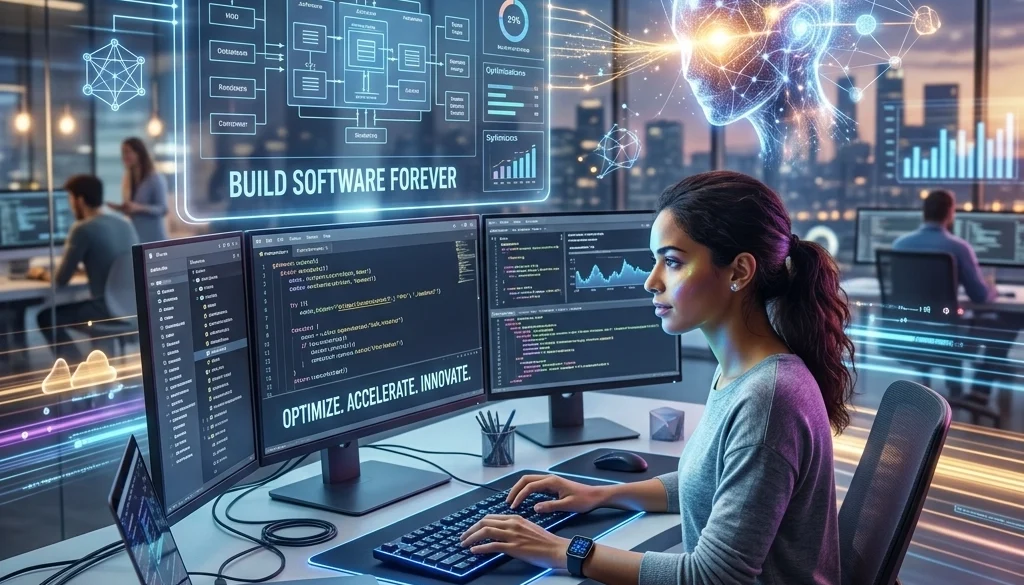
The traditional Software Development Life Cycle (SDLC) is being replaced by the AI-Driven Development Lifecycle (AI-DLC). In this new framework, the focus shifts from the manual construction of logic to the definition of intent. High-level objectives are processed by ai agents for business, which then architect, code, test, and deploy functional units with minimal human intervention. This transition represents a shift from "how to build" to "what to build."
The Mechanization of Development
Current data indicates that AI coding assistants and autonomous agents increase developer productivity by over 50%. The primary drivers of this efficiency are:
- Automated Syntax Generation: Manual coding of boilerplate and repetitive logic is eliminated.
- Autonomous Error Correction: AI agents identify and resolve bugs in real-time during the development phase.
- Dynamic Refactoring: Systems continuously optimize their own codebase for performance and maintainability.

Marketrun identifies this as the "Two-Shift Digital Factory" model. In this model, human engineers provide strategic oversight and architectural constraints during the primary shift. The secondary shift is executed by autonomous agents that perform heavy computational tasks, including unit testing, documentation, and vulnerability scanning. This model allows for 24/7 development cycles, significantly reducing time-to-market.
AI Agents for Business: The New Workforce
The deployment of ai agents for business is no longer a speculative venture. These agents operate as autonomous nodes within a corporate infrastructure, capable of handling complex workflows that previously required manual software integration.
At Marketrun, our vision for the next decade involves the integration of these agents into every layer of the business stack. This includes:
- Self-Healing Infrastructure: Systems that monitor their own health and deploy patches autonomously.
- Predictive Feature Deployment: Software that analyzes user behavior patterns to suggest and prototype new features without human prompting.
- Interoperable Ecosystems: Agents that facilitate seamless communication between disparate software tools via custom software solutions.
Custom AI Solutions for SMBs: Democratizing Technology
Historically, high-performance custom software was reserved for large enterprises with substantial R&D budgets. AI-driven engineering changes this economic reality. Custom ai solutions for smbs are now accessible due to the drastic reduction in engineering man-hours required for project completion.
By leveraging AI-driven platforms, Small and Medium-sized Businesses (SMBs) can achieve:
- Lower Entry Costs: Prototyping costs are reduced by up to 70%.
- Rapid Iteration: Feedback loops that previously took months are now compressed into days.
- Scalable Intelligence: AI models can be tailored to specific business niches without the need for an in-house data science team.
Marketrun specializes in bridging this gap, providing custom AI solutions for SMBs that are optimized for both performance and cost-efficiency.

The Economic Impact of AI-Driven Engineering
The financial implications of this shift are quantifiable. Traditional offshore development models are being re-evaluated as AI-assisted engineering provides higher quality output at lower price points. Comparative data on offshore web and mobile app development suggests that the primary value is no longer labor arbitrage, but rather the density of AI integration within the development team.
Organizations adopting AI-driven engineering report:
- Reduced Technical Debt: AI systems maintain higher standards of code cleanliness.
- Improved ROI: Investment in AI automation yields faster returns through accelerated product launches.
- Resource Allocation: Human capital is redirected from maintenance to innovation.
Self-Hosting and Data Sovereignty
As AI becomes central to software engineering, the security of the underlying models and data is paramount. Many businesses are moving away from third-party API dependencies in favor of self-hosting LLMs.
Self-hosting offers several critical advantages:
- Data Privacy: Sensitive proprietary codebases remain within the corporate firewall.
- Latency Reduction: Localized models provide faster inference times for real-time engineering tasks.
- Cost Control: Fixed infrastructure costs replace variable API usage fees.
Marketrun provides comprehensive support for self-hosting LLMs in 2026, ensuring that businesses retain full control over their intellectual property while benefiting from state-of-the-art AI capabilities.

Future Projections: 2026 to 2036
The next decade will see the total integration of AI into the fabric of software engineering. The distinction between "software developer" and "systems architect" will continue to blur.
The Rise of Natural Language Engineering
Natural language will become the primary interface for software creation. While the underlying code remains complex, the "human" interface will be entirely conversational and visual. This will allow business stakeholders to participate directly in the development process through ai website creation and automated workflow builders.
Autonomous Product Evolution
Software will no longer be static. AI-driven systems will continuously evolve based on real-time data inputs. This includes autonomous SEO adjustments and AI-driven website optimizations that ensure maximum visibility and conversion without manual intervention.

Strategic Implementation for Organizations
To remain competitive in this evolving landscape, organizations must adopt a systematic approach to AI integration. This involves:
- Assessment of Current Workflows: Identify high-friction areas in the existing development process.
- Pilot Programs: Implement ai agents for business in controlled environments to measure efficacy.
- Infrastructure Scaling: Transition to hybrid or self-hosted models to support increasing computational demands.
- Upskilling Personnel: Train existing engineering teams in AI orchestration and prompt engineering.
Marketrun offers specialized consulting and development services for clients in both the US and India, focusing on the implementation of high-ROI AI strategies.
Verification and Quality Assurance in an AI-First World
The transition to AI-driven engineering necessitates new methods of verification. As code is generated at superhuman speeds, the bottleneck shifts to quality assurance (QA). Automated testing frameworks must evolve to become "AI-aware," utilizing machine learning to predict potential failure points and generate comprehensive test cases autonomously.
Key components of modern QA include:
- Formal Verification: Mathematical proofs of code correctness generated by AI.
- Continuous Security Scanning: Real-time identification of vulnerabilities during the generation phase.
- Performance Benchmarking: Automated comparison of generated code against efficiency standards.

The Conclusion of Manual Engineering
Manual software engineering is entering a period of obsolescence. The capacity to build software is no longer limited by the number of human hours available, but by the clarity of the vision and the effectiveness of the AI agents employed.
Marketrun remains at the forefront of this transformation, providing the tools and expertise necessary for businesses to navigate the transition from traditional development to AI-driven engineering. The future of software is not just written by AI; it is defined by the strategic integration of AI agents into every facet of the business operation.
For further information on pricing and service tiers, visit the Marketrun pricing page. To explore more insights on the future of technology, visit the Marketrun blog.