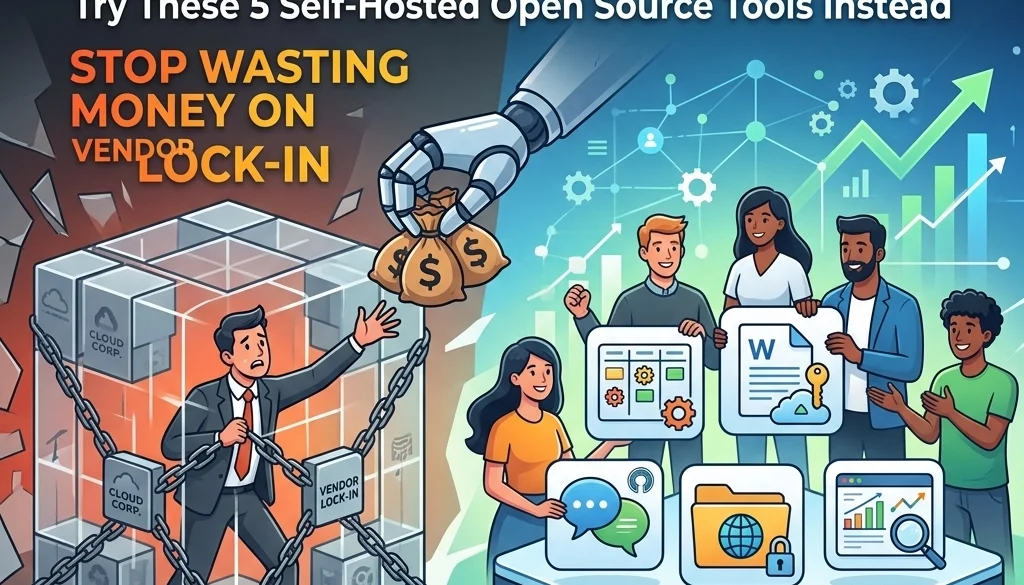
Stop Wasting Money on Vendor Lock-in: Try These 5 Self-Hosted Open Source Tools Instead
Status: The Economic Impact of Vendor Lock-in
Vendor lock-in is a state where a consumer is restricted to a single provider for a specific product or service. This restriction is enforced by high switching costs, proprietary data formats, and integrated ecosystems. In the current software landscape, the Software-as-a-Service (SaaS) model serves as the primary driver of this phenomenon.
Financial extraction occurs through tiered pricing, seat-based licensing, and API usage fees. As enterprise data scales, these costs increase non-linearly. Data portability is often restricted, making the transition to alternative platforms technically difficult and resource-intensive.
Self-hosted open source tools provide a mitigation strategy. Control over infrastructure is maintained. Data resides on owned or leased hardware. Subscription cycles are terminated. Customization is permitted through access to the underlying source code.
Status: Technical Framework for Self-Hosting
Self-hosting requires an infrastructure stack capable of managing containerized applications. Linux-based servers are utilized for stability. Docker and Docker Compose are the industry standards for deployment.
The following components are essential for a robust self-hosted environment:
- Compute: Virtual Private Servers (VPS) or on-premise hardware.
- Containerization: Docker for isolation and reproducibility.
- Reverse Proxy: Traefik or Nginx for SSL termination and traffic routing.
- Backups: Automated snapshots and off-site data replication.
- Monitoring: Performance tracking via Prometheus or Grafana.
Managed services for these deployments are available through Marketrun open source deployment.
Tool 1: Supabase (Backend-as-a-Service Alternative)
Supabase is an open-source alternative to Firebase. It provides a full backend suite built on top of PostgreSQL.
Core Components
- PostgreSQL Database: A relational database for structured data management.
- GoTrue: An authentication API for user management and social logins.
- PostgREST: A tool that transforms the database into a RESTful API.
- Realtime: A server for listening to database changes over WebSockets.
- Storage: A service for managing large files and media.
Deployment Methodology
Deployment is facilitated via Docker. The repository is cloned from GitHub. Configuration is managed through a .env file where database credentials and API keys are defined. Running docker-compose up -d initializes the services.
Advantages over Firebase
Proprietary lock-in is avoided. Data is stored in standard SQL format, allowing for seamless export. Resource limits are determined by hardware specifications rather than vendor-imposed quotas. Custom extensions for PostgreSQL can be implemented without restriction.
For complex implementations, Marketrun custom software services provide technical assistance.

Tool 2: n8n (Workflow Automation)
n8n is a fair-code, node-based workflow automation tool. It serves as a direct alternative to Zapier and Make.
Operational Features
- Node-Based Interface: Visual workflow construction.
- 400+ Integrations: Connectivity with diverse third-party services.
- Custom Functions: Ability to write JavaScript for complex data manipulation.
- Internal Triggers: Support for Webhooks, Cron jobs, and polling.
Deployment and Scalability
n8n is deployed using Docker. It can be executed in 'Queue Mode' for high-volume processing, utilizing Redis and multiple workers. Data remains within the controlled environment, ensuring compliance with privacy regulations such as GDPR.
Economic Comparison
Zapier and Make charge per task or operation. As automation complexity increases, costs scale exponentially. n8n allows for unlimited workflow executions. The only cost is the underlying compute resource. Businesses requiring enterprise-grade stability utilize n8n deployment services to ensure uptime and security.

Tool 3: Ollama (Local LLM Execution)
Ollama is a tool for running Large Language Models (LLMs) locally. It provides an alternative to proprietary APIs like OpenAI or Anthropic.
Technical Capabilities
- Model Support: Execution of Llama 3, Mistral, Gemma, and Phi-3.
- Local API: Provides a local endpoint compatible with existing AI tooling.
- Privacy: Data processing occurs entirely on the local machine. No data is sent to external servers for training or inference.
- Cost Efficiency: Token-based fees are eliminated.
Implementation
Ollama is installed as a binary or container. Models are pulled using a command-line interface. Integration with internal applications is achieved through the provided REST API. This is critical for businesses handling sensitive intellectual property or regulated data.
Further details on local AI implementation are found in the Marketrun guide to self-hosting LLMs.

Tool 4: Vaultwarden (Security and Password Management)
Vaultwarden is an unofficial Bitwarden server implementation written in Rust. It is designed for lightweight deployment while maintaining full compatibility with official Bitwarden clients.
Security Features
- End-to-End Encryption: Master password is used for client-side encryption.
- Two-Factor Authentication (2FA): Support for YubiKey, TOTP, and Duo.
- Organization Support: Shared vaults for team credential management.
- Resource Efficiency: Low memory and CPU footprint compared to the official C# implementation.
Strategic Value
Dependency on centralized password managers is removed. The risk of vendor-side breaches impacting company credentials is mitigated. Control over the database allows for rigorous backup and disaster recovery protocols.
Tool 5: Immich (Media and Asset Management)
Immich is a high-performance self-hosted backup solution for photos and videos. It functions as an alternative to Google Photos and iCloud.
Functional Specifications
- Mobile Sync: Automatic backup from iOS and Android devices.
- Machine Learning: Face recognition and object detection for automated tagging.
- Multi-user Support: Isolated libraries for different team members or family members.
- Performance: Optimized for large libraries containing hundreds of thousands of assets.
Data Sovereignty
Storage costs on commercial cloud platforms scale as media resolution increases. Immich utilizes local storage or Network Attached Storage (NAS). Proprietary compression algorithms used by cloud vendors are bypassed, preserving original file integrity.

Status: Operational Maintenance and Governance
Transitioning to self-hosted open source tools requires a shift in operational governance. Responsibility for maintenance is moved from the vendor to the internal team or a specialized partner.
Maintenance Checklist
- Updates: Regular pulling of new Docker images to patch security vulnerabilities.
- Backups: Daily replication of volumes and databases to an off-site location.
- Logs: Aggregation and analysis of system logs to detect anomalies.
- Hardware Health: Monitoring of CPU, RAM, and disk utilization.
Failure to maintain these systems results in downtime and potential data loss. Professional management through Marketrun pricing models provides a middle ground between total vendor lock-in and the overhead of manual maintenance.
Status: Deployment Strategy
Implementation should follow a phased approach:
- Audit: Identify high-cost SaaS subscriptions.
- Pilot: Deploy a single tool (e.g., n8n) in a testing environment.
- Migration: Transfer data from the proprietary service to the self-hosted alternative.
- Validation: Verify data integrity and workflow functionality.
- Production: Decommission the SaaS subscription.
The elimination of vendor lock-in facilitates long-term financial stability. Software ownership ensures that the tools used by a business are assets rather than liabilities.
For assistance in designing and deploying custom software architectures, refer to Marketrun custom software solutions.

Status: Conclusion
Self-hosting open source tools is a viable strategy for reducing operational expenditure. Supabase, n8n, Ollama, Vaultwarden, and Immich represent mature alternatives to market-leading proprietary platforms. Data ownership and infrastructure control are restored.
Technical complexity is mitigated through containerization and managed deployment services. The move away from vendor lock-in is a prerequisite for software autonomy in 2026.
Additional resources on AI agents and automation can be found in the Marketrun automation guide. For specific regional inquiries, information is available for US clients and India clients.